
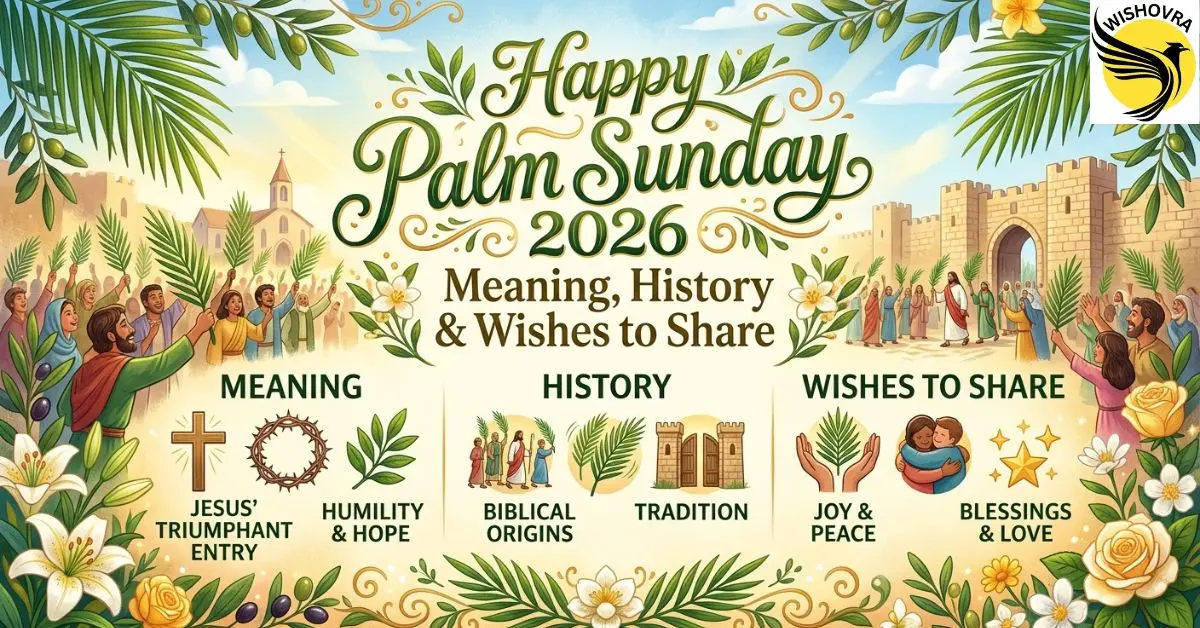
Happy Palm Sunday 2026: Meaning, History & Wishes to Share
Happy Palm Sunday is one of the most significant days in the Christian calendar. Known also as the Sixth Sunday of Lent or Palm and Passion Sunday, it is a moveable feast that falls on the Sunday before Easter.
This day marks the beginning of Holy Week and commemorates the Triumphal entry into Jerusalem — the moment when Jesus Christ entered the city of Jerusalem to widespread celebration, just days before his Passion, Crucifixion, and Resurrection.
What Is Palm Sunday?
Palm Sunday Wishovra gets its name from the palm branches that crowds waved and laid on the ground to honor Jesus Christ as he rode into Jerusalem. This event, known as the Entry of Jesus Christ into Jerusalem or the Entry of the Lord into Jerusalem, is recorded in all four Gospels — the Gospel of Matthew, Gospel of Mark, Gospel of Luke, and Gospel of John.
In Western Christianity, Happy Palm Sunday opens the final week of Lent, leading into Eastertide. In Eastern Christianity, Holy Week begins only after Great Lent concludes, making Palm Sunday the bridge between the two seasons.
The day is also connected to the Raising of Lazarus, an event mentioned specifically in the Gospel of John and commemorated the day before on Lazarus Saturday.
The Biblical Basis and Symbolism
According to scripture, Jesus rode into Jerusalem not on a horse, but on a donkey, along with its colt — the foal of a donkey. This detail fulfills the prophecy found in Zechariah 9:9, which describes a king arriving “lowly and riding on a donkey.”
Riding a horse was traditionally associated with a king going to war, while a donkey symbolized peace. By choosing a donkey, Jesus was seen as declaring himself the Prince of Peace rather than a warlike King of Israel.
As Jesus approached the city, according to the Gospel of Luke, he wept over Jerusalem — an event referred to as Flevit super illam (He wept over it) — foretelling the suffering the city would face, later linked to the destruction of the Second Temple.
Crowds gathered along Jesus’ path, laying down their garments and cut branches, singing lines from Psalm 118, including the now-famous phrase “Blessed is He who comes in the name of the Lord.” The Gospel of John specifically mentions Happy Palm Sunday fronds, connecting the event to the Jewish tradition of the Four Species used during Sukkot, as prescribed in Leviticus 23:40.
Palm branches carried deep symbolic meaning across ancient cultures. In the Greco-Roman world, palm branches represented triumph and victory and were closely associated with the goddess Nike or Victoria — echoing the ceremonial procession of a Roman triumph.
In ancient Egyptian religion, palms symbolized eternal life and were carried in funeral processions. Over time, Christian tradition adopted the palm as the martyr’s Happy Palm Sunday, a symbol of spiritual victory over death, an image that also appears in the Book of Revelation 7:9, where a multitude stands before the throne holding palm branches.
How Palm Sunday Is Observed in the Liturgy
Eastern and Oriental Christianity
In the Eastern Orthodox Church and Eastern Catholic Churches, Happy Palm Sunday is one of the Twelve Great Feasts of the liturgical year. Following the Byzantine Rite, churches often change their hangings and vestments to festive green. The Troparion of the Feast, a hymn recited during the liturgy, links the raising of Lazarus with the promise of universal resurrection.
Because palm trees are not always available in colder regions, willow branches, pussy willow, and box tree twigs are commonly substituted in Russian, Ukrainian, Polish, Bavarian, and Austrian traditions, among Eastern Lutheran Churches and Ruthenian Catholic communities as well.
These branches are blessed and distributed either during the All-Night Vigil the evening before, or before the Divine Liturgy itself.
The Great Entrance of the Divine Liturgy holds special meaning on this day, as the faithful stand holding blessed branches and lit candles, later taking them home to place in their icon corner as an evloghia, or blessing.
Historically, Moscow and Novgorod held elaborate donkey walk processions, where the Patriarch of Moscow rode a horse dressed to resemble a donkey, symbolically representing Christ, while the Tsar of Russia walked humbly on foot leading the procession.
This tradition, altered by Patriarch Nikon in 1658, was eventually ended by Peter I in the 1720s as part of broader church reforms, though it has occasionally been recreated in modern times.
In Oriental Orthodox churches, Happy Palm Sunday fronds are distributed near the sanctuary steps, and in India, the sanctuary is often strewn with marigolds as the congregation moves through the church.
Western Christianity
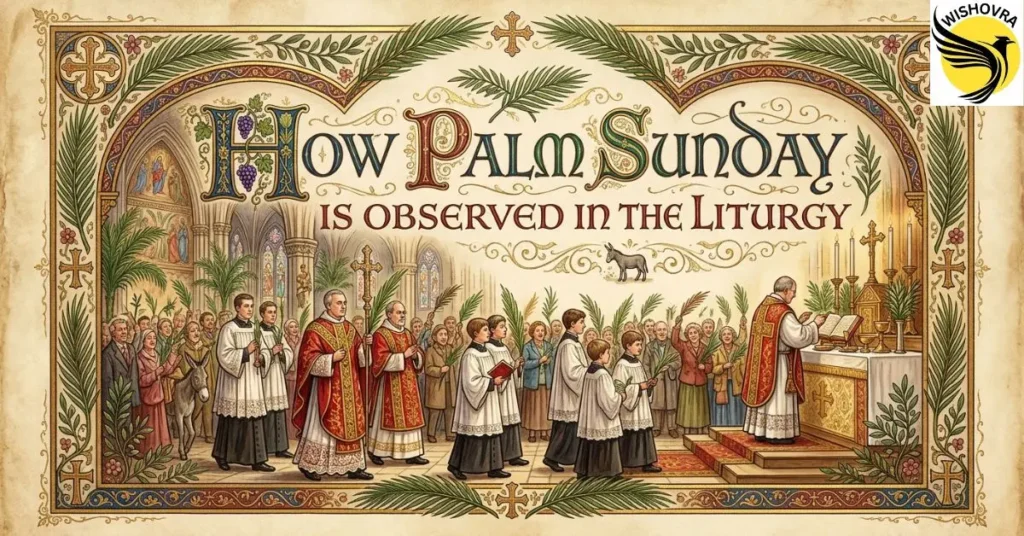
In many Western denominations — Roman Catholic, Lutheran, Anglican, and others — palm branches are blessed with holy water outside the church in a ceremony called the Blessing of the Palms, followed by a formal Palm procession. In colder climates, this blessing sometimes takes place inside the narthex instead.
In the Catholic, Lutheran, and Anglican traditions, this day is also referred to as Passion Sunday, since the Mass that follows focuses on Christ’s Passion. The Catholic Church regards blessed palms as sacramentals, and the liturgical vestments worn are deep scarlet red, symbolizing the blood and sacrifice central to the day’s meaning.
Congregations, often including children, carry Happy Palm Sunday in procession around the inside of the church. In the Church of Pakistan, worshippers carry palm branches while singing Psalm 24.
Over the centuries, a rich hymnody has grown around the occasion, including well-known hymns such as “Hosanna, Loud Hosanna,” “Ride On, Ride On in Majesty!,” “All Glory, Laud and Honour,” “Palms of Victory,” and “Hark the glad sound! the Saviour comes.”
Customs and Traditions Around the World
Palm Sunday customs vary widely, especially in regions where fresh palm leaves are not naturally available.
Belgium – In Hoegaarden, a fellowship representing the Twelve Apostles carries a wooden statue of Christ through town, while children collect coins by offering box branches door to door.
Bulgaria – Known as Tsvetnitsa or Vrabnitsa, meaning “Flower’s Day,” this day is also the name day for people whose names relate to flowers.
England – Historically, Happy Palm Sunday was marked by burning Jack o’ Lent effigies, a straw figure symbolically punished as a stand-in for Judas Iscariot or for winter itself.
Egypt and Ethiopia – In the Coptic Orthodox Church and Orthodox Ethiopia, the day is called Hosanna, with palm leaves blessed and woven into crosses and rings.
Finland – Children dress as Easter witches and go door to door trading decorated pussy willow branches for treats, a custom called virpominen, accompanied by traditional chants wishing health and luck.
Germany – Long stakes decorated with pussy willow and box twigs replace simple branches in some regions, and a wooden donkey figure known as the Palmesel is sometimes part of the procession.
India – Happy Palm Sunday are blessed and distributed after Mass, often folded into palm crosses. In Kerala, flowers are scattered in the sanctuary during the Gospel reading as the congregation repeats “Hosanna!” This tradition traces back to the arrival of Saint Thomas the Apostle.
Ireland – Since palm leaves are hard to source, yew, silver fir, spruce, or cypress branches are used instead, giving rise to the Irish name Domhnach an Iúir, meaning “Yew Sunday.”
Italy – Palm leaves combined with small olive branches are braided and hung above doorways, lasting until the following year’s Palm Sunday.
Latvia – Referred to as “Pussy Willow Sunday,” branches symbolizing new life are blessed and distributed, sometimes accompanied by playful ritual swats to wake children.
Lithuania – Instead of palms, dwarfed spruce branches called “verba” are decorated with flowers by women ahead of the celebration.
The Levant (Israel, Jordan, Lebanon, Palestine, Syria) – Known as Shaa’nineh, this is often the best-attended liturgy of the year, with children carrying olive and palm branches and priests sprinkling holy water using olive branches.
Malta – Parishes bless both palm and olive leaves, and olive branches are placed on statues depicting scenes from Christ’s Passion.
Netherlands – In Saxon regions, crosses are decorated with candy and rooster-shaped bread, alongside a nighttime procession with oil lamps.
Philippines – A statue of Christ riding a donkey, called the Humenta, is carried in procession while congregants wave palaspás, ornately woven palm branches, and children dressed as angels scatter flowers. Blessed palaspás are later placed at home altars and doorways.
Poland – Towns like Lipnica Murowana and Łyse hold competitions for the tallest decorated Easter palm, with some exceeding 30 meters in length.
Romania and Moldova – Called Duminica Floriilor or simply Florii, meaning “Flowers’ Sunday,” the celebration has roots in a pre-Christian fertility festival.
Spain – The Palmeral of Elche, Europe’s largest palm grove, is famous for whitened, intricately braided palm leaves. Tradition also holds that people should wear something new on this day.
Syria – Children go door to door chanting about the rising of Lazarus, collecting coins or eggs in return.
Wales – Known as Sul y Blodau or “Flowering Sunday,” this tradition involves cleaning and decorating graves with flowers, a custom historically tied to both Easter and Palm Sunday celebrations in South Wales.
What Happens to the Palms After the Blessing?
Christians typically take blessed palm branches home, hanging them beside Christian art such as crosses and crucifixes, or keeping them tucked into Bibles and devotional books.
In Western Christianity, many churches collect the previous year’s dried palms before the next Lent, during Shrovetide or Carnival, and burn them to produce the ashes used on Ash Wednesday, marking the start of Lent. In Eastern Christianity, where Ash Wednesday does not exist, believers usually return their old palms the following Palm Sunday before receiving new ones.
Why Palm Sunday Still Matters
Palm Sunday holds deep significance because it captures a moment of both celebration and foreboding. The crowds welcomed Jesus as a king, yet within days he would face arrest, trial, and crucifixion.
This contrast between triumphant entry and impending sacrifice is why the day is also called Passion Sunday in several traditions — the joy of the procession is inseparable from the solemnity of what follows during Holy Week.
The connection between Palm Sunday and Easter is also reflected in the moveable nature of the feast. Because Easter itself shifts each year based on the lunar calendar, Palm Sunday’s date changes accordingly, differing between the Western and Eastern calendars.
Final Thoughts
From its biblical roots in the Triumphal entry into Jerusalem to the diverse customs practiced across Belgium, Bulgaria, Finland, Germany, India, Ireland, Italy, Latvia, Lithuania, the Levant, Malta, the Netherlands, the Philippines, Poland, Romania, Moldova, Spain, Syria, and Wales, Palm Sunday remains one of the most widely observed days in the Christian liturgical year.
Whether marked by palm fronds, willow branches, olive leaves, or spruce twigs, the day continues to carry its central message across centuries and cultures: the arrival of Christ as the Prince of Peace, welcomed with Hosanna, just before the solemn events of Holy Week, Good Friday, and Easter unfold.
FAQs:
What does “Happy Palm Sunday” mean?
“Happy Palm Sunday” is a greeting used to wish someone joy and blessings on Palm Sunday, the day Christians commemorate Jesus’ triumphant entry into Jerusalem. It reflects the celebratory spirit of the occasion, even though it also marks the start of the more solemn Holy Week.
When do people say Happy Palm Sunday?
People say Happy Palm Sunday on the Sunday before Easter, which is a moveable date that changes every year based on the Christian liturgical calendar. It’s common to greet family, friends, and church members with this wish either at church or through messages and cards.
Is it appropriate to wish someone “Happy Palm Sunday”?
Yes, it is completely appropriate and widely practiced. While the day carries deep religious meaning, wishing someone a Happy Palm Sunday is a warm and respectful way to acknowledge the occasion and share in the spirit of celebration and faith.
What is usually included in a Happy Palm Sunday message?
A typical Happy Palm Sunday message includes blessings, references to palm branches, hope, peace, and sometimes a short prayer or scripture line. Many people also mention themes of humility and gratitude, reflecting the meaning behind the day.
Why is Palm Sunday called a “happy” day despite leading into Holy Week?
Palm Sunday is called a happy day because it celebrates the joyful welcome Jesus received when entering Jerusalem. Even though it precedes the more reflective and solemn days of Holy Week, the day itself is rooted in celebration, hope, and triumph.

Muhammad Ahmad is the founder and content writer of Wishovra.com with 5+ years of experience in creating wishes, greetings, and special occasion messages. He specializes in writing meaningful and easy-to-share content for birthdays, anniversaries, festivals, and celebrations. His goal is to help readers find the perfect words for every special moment.