Introduction to Programmable Matter Research in 2026
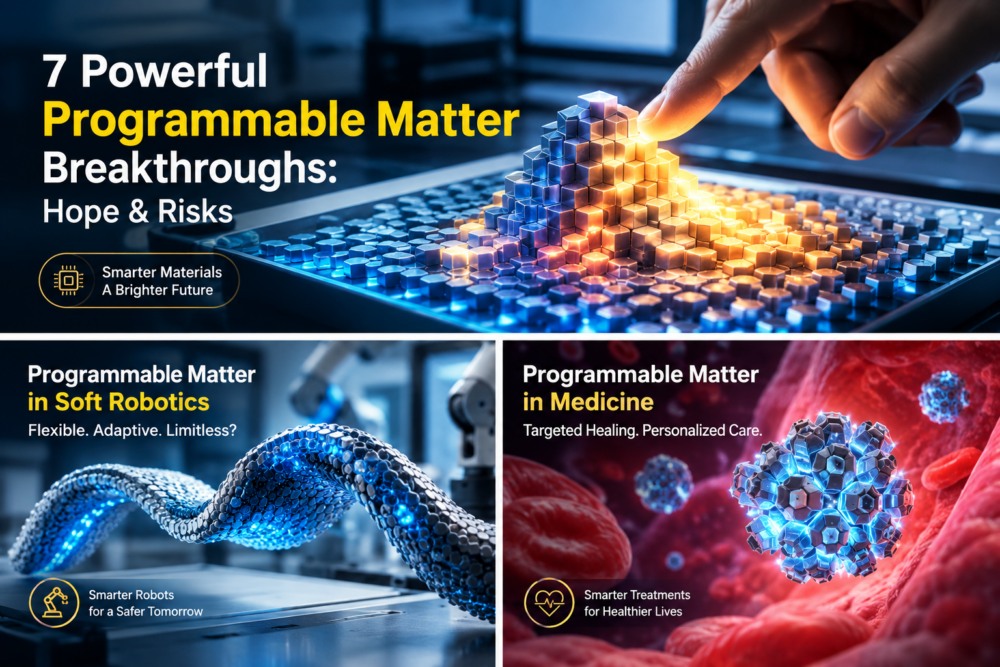
Programmable Matter is an emerging area of science and engineering that explores how physical materials could change their shape, properties, or behavior in response to digital instructions, environmental conditions, or external signals. In 2026, programmable matter research continues to attract interest because it could transform robotics, medical devices, construction, manufacturing, and smart materials. Instead of using a fixed object for only one purpose, researchers are investigating materials and systems that can adapt to different tasks 7 Powerful Programmable Matter Breakthroughs: Hope & Risk.
The idea sounds like science fiction, but several related technologies already exist. Shape-changing polymers, modular robots, responsive hydrogels, and materials with embedded sensors demonstrate parts of this vision. However, a fully general-purpose material that can freely transform into almost any object remains a major research challenge. Understanding the difference between current achievements and future possibilities is essential when examining programmable matter breakthroughs.
This article explores seven promising directions in programmable matter research, their potential benefits, and the hidden risks that researchers must address.

Table of Contents
- Programmable Matter and Shape-Changing Materials
- Programmable Matter in Modular Robotics
- Programmable Matter for Medical Applications
- Programmable Matter in Smart Construction
- Programmable Matter and 4D Printing
- Programmable Matter for Adaptive Electronics
- Programmable Matter and Sustainable Manufacturing
- Programmable Matter Research Comparison Table
- Programmable Matter Research Graph
- Benefits, Risks, and Future Outlook
1. Programmable Matter and Shape-Changing Materials
One of the most fascinating directions in programmable matter research is the development of materials that can change shape when exposed to heat, light, moisture, magnetic fields, or electrical signals. These materials are designed to respond to particular conditions instead of remaining permanently fixed 7 Powerful Programmable Matter Breakthroughs: Hope & Risks.
Shape-memory polymers, for example, can be deformed and later return toward a previously programmed shape under suitable conditions. Other responsive materials can bend, swell, contract, or change stiffness. Researchers are exploring how these properties might help create adaptable product designs and objects that perform multiple functions.
How Programmable Matter Changes Shape
The process usually begins with a material engineered to respond to a particular stimulus. Scientists then design the material’s structure and the conditions that trigger its movement. In some systems, a computer controls the stimulus; in others, the material responds directly to its surroundings 7 Powerful Programmable Matter Breakthroughs: Hope & Risks.
Hope and Hidden Risks of Programmable Matter
The potential benefit is that one object could adapt to several different uses, reducing the need for multiple specialized components. However, many responsive materials have limited movement, slow response times, durability problems, or demanding operating conditions. Their performance must be tested before they can replace conventional products.
2. Programmable Matter in Modular Robotics
Modular robotics is another important area connected to programmable matter. Instead of constructing a robot as one permanent machine, engineers develop smaller modules that can connect, separate, or rearrange themselves to perform different tasks 7 Powerful Programmable Matter Breakthroughs: Hope & Risks.
For example, a group of robotic modules might form a crawling machine for one task and rearrange into a different structure for another. Each module may contain sensors, actuators, a communication system, or a power source. The challenge is coordinating all these parts reliably.
Why Programmable Matter Could Improve Robotics
Adaptable robotic structures could be useful in warehouses, disaster-response operations, scientific exploration, and environments where the required task changes frequently. A modular system might adapt its configuration instead of requiring a completely new robot for every situation 7 Powerful Programmable Matter Breakthroughs: Hope & Risks.
Programmable Matter Challenges in Modular Robotics
Connection reliability, energy consumption, movement accuracy, and communication between modules remain important obstacles. A single module failure could affect the entire structure. Engineers also need to make these systems safe around people and robust enough for real-world environments 7 Powerful Programmable Matter Breakthroughs: Hope & Risks.
3. Programmable Matter for Medical Applications
Medicine offers another promising direction for programmable matter research. Scientists are investigating responsive materials that can change shape or behavior under specific biological conditions. Such materials could eventually support medical devices, tissue engineering, drug delivery systems, and minimally invasive procedures 7 Powerful Programmable Matter Breakthroughs: Hope & Risks.
Hydrogels are particularly interesting because they can absorb water and change their volume in response to environmental conditions. Researchers are exploring how carefully engineered hydrogels might respond to temperature, acidity, or other signals relevant to biological systems.

Potential Benefits of Programmable Matter in Healthcare
In the future, responsive materials could help medical devices adapt to a patient’s needs or support targeted delivery of therapeutic substances. Soft structures may also be useful where flexibility is more suitable than rigid mechanical components 7 Powerful Programmable Matter Breakthroughs: Hope & Risks.
Safety Risks of Medical Programmable Matter
Medical applications require much more than successful shape transformation. Materials must be biocompatible, predictable, and safe over the intended period of use. Researchers must examine toxicity, immune responses, degradation, contamination, and the possibility of unintended movement. Many proposed applications remain experimental and should not be confused with routinely available medical treatments.
4. Programmable Matter in Smart Construction
The construction industry could benefit from materials and structures that adjust to changing environmental conditions. Programmable matter concepts may support adaptive shading, responsive building surfaces, deployable structures, and components that change their configuration when needed 7 Powerful Programmable Matter Breakthroughs: Hope & Risks.
For example, a building facade could use responsive elements to control sunlight or ventilation. Instead of relying entirely on motors and complex mechanical systems, some designs may use materials that react to heat, humidity, or light.
How Programmable Matter Could Improve Buildings
Adaptive structures may improve indoor comfort and help reduce unnecessary energy use. Lightweight deployable components could also be useful in temporary shelters, portable facilities, or equipment designed for remote locations 7 Powerful Programmable Matter Breakthroughs: Hope & Risks.
Hidden Risks of Programmable Matter in Construction
Building materials must withstand years of weather exposure, repeated movement, and changing loads. A responsive surface that works in a laboratory may behave differently in rain, dust, extreme temperatures, or strong winds. Long-term maintenance, fire safety, repair costs, and structural reliability must be evaluated before widespread adoption.
5. Programmable Matter and 4D Printing
Four-dimensional printing, commonly called 4D printing, extends the concept of 3D printing by creating structures designed to change over time in response to a stimulus. The fourth dimension refers to the transformation that occurs after the object has been manufactured 7 Powerful Programmable Matter Breakthroughs: Hope & Risks.
This approach can combine carefully arranged materials, geometric patterns, and programmed responses. A printed structure might fold, bend, or expand when exposed to moisture, heat, or another trigger.
The Connection Between Programmable Matter and 4D Printing
Programmable matter describes a broad vision of materials and objects that can alter their behavior, while 4D printing is one possible manufacturing approach for creating certain shape-changing structures. The two fields overlap, but they are not identical 7 Powerful Programmable Matter Breakthroughs: Hope & Risks.
What Limits Programmable Matter Through 4D Printing?
Researchers must control how quickly a printed object transforms, how accurately it reaches its intended shape, and how many times it can repeat the process. Material selection and manufacturing costs are also significant. Complex transformations can be difficult to predict, particularly when multiple materials respond differently to the same conditions.
6. Programmable Matter for Adaptive Electronics
Electronics could become more flexible and adaptable through materials that respond to movement, pressure, temperature, or electrical input. Research into flexible circuits, stretchable sensors, and reconfigurable electronic structures provides building blocks for this direction 7 Powerful Programmable Matter Breakthroughs: Hope & Risks.
Instead of using rigid components in every application, future devices may combine flexible materials with embedded sensing and control systems. These technologies could be useful in wearable devices, soft robotics, human-machine interfaces, and equipment that must fit unusual shapes.
How Programmable Matter Could Support Smart Devices
An adaptable electronic surface might change its shape to fit a user’s body or alter its configuration for a particular task. Responsive sensors could also help systems react to environmental changes without requiring every function to be controlled manually 7 Powerful Programmable Matter Breakthroughs: Hope & Risks.
Privacy and Reliability Risks of Programmable Matter
Connected adaptive devices may collect sensitive information about movement, location, or physical surroundings. Security weaknesses could allow unauthorized access or interfere with device behavior. Researchers and manufacturers must consider data protection, software reliability, repairability, and safe failure modes alongside material performance.
7. Programmable Matter for Sustainable Manufacturing
Sustainability is another reason researchers are interested in programmable matter. Materials that can perform multiple functions may reduce the number of separate components needed in some products. Reconfigurable structures could also make certain equipment easier to adapt, repair, or reuse 7 Powerful Programmable Matter Breakthroughs: Hope & Risks.
For example, a reusable modular product might be rearranged for a different purpose instead of being discarded when its original function is no longer needed. Responsive materials could also support lightweight designs, potentially reducing material use in selected applications.
Can Programmable Matter Reduce Waste?
The answer depends on how the material is manufactured, powered, maintained, and eventually recycled. A product that lasts longer and supports repeated reuse could offer environmental advantages. However, a complex responsive material that is difficult to repair or separate into recyclable components may create new waste problems 7 Powerful Programmable Matter Breakthroughs: Hope & Risks.
The Environmental Risks of Programmable Matter
Some advanced materials require energy-intensive production, specialized chemicals, electronic components, or rare resources. Their environmental impact cannot be judged by appearance or functionality alone. Researchers need lifecycle assessments that consider raw materials, manufacturing, transportation, use, repair, and disposal.
8. Programmable Matter Research Comparison Table
The following table summarizes important research directions connected to programmable matter. It is a qualitative overview, not a ranking of verified 2026 breakthroughs or a measurement of commercial readiness.
| Research area | Potential application | Main opportunity | Key challenge |
|---|---|---|---|
| Shape-changing materials | Adaptive products | Reconfigurable shapes | Durability and control |
| Modular robotics | Flexible robots | Multiple configurations | Coordination and energy |
| Medical responsive materials | Drug delivery and devices | More adaptable treatment tools | Biocompatibility and safety |
| Smart construction | Responsive facades | Adaptive building performance | Weather resistance |
| 4D printing | Transforming structures | Programmed shape changes | Precision and repeatability |
| Adaptive electronics | Wearables and soft devices | Flexible functionality | Security and reliability |
| Sustainable manufacturing | Reusable products | Potential waste reduction | Recycling and lifecycle impacts |
The comparison shows that programmable matter is not one single invention. It is a broad research direction built from materials science, robotics, manufacturing, electronics, and computer control. Each area faces different technical and safety requirements.
9. Programmable Matter Research Graph
The graph below is a conceptual illustration of how different research areas could be compared by their potential application breadth. The values are illustrative scores from 1 to 10, created for this article; they are not measured scientific results, research funding figures, or an official 2026 ranking 7 Powerful Programmable Matter Breakthroughs: Hope & Risks.
| Research area | Illustrative application-breadth score |
|---|---|
| Shape-changing materials | 8 |
| Modular robotics | 8 |
| Medical applications | 7 |
| Smart construction | 7 |
| 4D printing | 8 |
| Adaptive electronics | 8 |
| Sustainable manufacturing | 9 |
The higher illustrative score for sustainable manufacturing represents its potential relevance across several industries, not proof that it is the most advanced or effective area. Real comparisons would require defined evaluation criteria and current experimental evidence.
10. Programmable Matter Benefits, Risks, and Future Outlook
Programmable matter could eventually make products more adaptable, support new robotic capabilities, and create materials that respond to their environments. It may also help engineers rethink how devices are manufactured, repaired, and reused 7 Powerful Programmable Matter Breakthroughs: Hope & Risks.
However, the gap between a successful laboratory demonstration and a dependable commercial product can be large. Researchers must improve energy efficiency, transformation accuracy, durability, affordability, and control. Medical and building applications also require strict safety testing, while connected systems need strong cybersecurity protections.
What Could Programmable Matter Research Achieve Next?
Future progress may come from combining responsive materials with miniature sensors, better control algorithms, modular engineering, and advanced manufacturing. Researchers may develop systems that change shape more precisely, operate repeatedly, or respond to several environmental signals.
The most meaningful advances will not simply be materials that move in impressive ways. They will be systems that perform useful tasks reliably, safely, and at a reasonable cost.
Conclusion: The Future of Programmable Matter
Programmable matter research offers an exciting vision in which materials and objects can adapt instead of remaining permanently fixed. Shape-changing polymers, modular robots, responsive hydrogels, 4D printing, and flexible electronics already demonstrate parts of this broader concept 7 Powerful Programmable Matter Breakthroughs: Hope & Risks.
Yet important limitations remain, including energy requirements, material durability, control complexity, safety, and environmental impact. Many ambitious applications are still under investigation, and their practical value will depend on continued testing and engineering improvements 7 Powerful Programmable Matter Breakthroughs: Hope & Risks.
In 2026, programmable matter is best understood as a developing research field rather than a universal technology that can instantly transform any object. Its future will depend on whether scientists can turn promising demonstrations into affordable, dependable, and responsible solutions for real-world problems 7 Powerful Programmable Matter Breakthroughs: Hope & Risks.