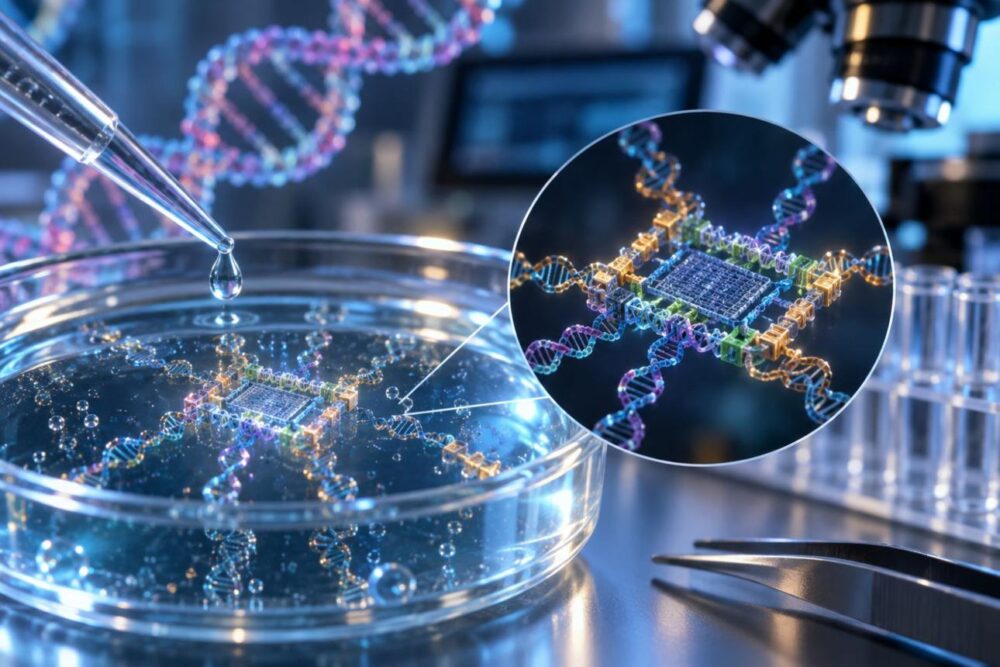
Biological computing is an emerging field that combines biology, chemistry, and computer science to process information using biological molecules, living cells, or neural tissues. In 2026, Biological Computing research is exploring new ways to perform calculations with DNA molecules, program cellular behavior, and investigate computing systems built with laboratory-grown neural organoids. Recent research includes advances in DNA-based molecular computers and brain-inspired biological systems 7 Powerful Biological Computing Breakthroughs: Hope & Risks.
Unlike conventional computers that rely on electronic circuits, biological computing can use molecular reactions or the activity of living cells to perform particular tasks. These systems are not replacements for ordinary computers in every situation. Instead, they may eventually offer specialized ways to solve problems in medicine, biotechnology, scientific research, and information processing 7 Powerful Biological Computing Breakthroughs: Hope & Risks.

This article explores seven promising biological computing research directions, their potential benefits, their limitations, and the hidden risks scientists must address before these technologies become widely useful.
Table of Contents
- Biological Computing and DNA-Based Computers
- Biological Computing with Living Cells
- Biological Computing and Brain Organoids
- Biological Computing for Medical Research
- Biological Computing and Synthetic Biology
- Biological Computing for Smart Materials
- Biological Computing and Energy-Efficient Processing
- Biological Computing Research Comparison Table
- Biological Computing Research Graph
- Benefits, Risks, and Future Outlook
1. Biological Computing and DNA-Based Computers
DNA is best known for storing genetic information, but its molecular properties also make it useful for certain types of computation. DNA molecules can interact through predictable base-pairing rules, allowing researchers to design molecular systems that represent information and perform specific operations 7 Powerful Biological Computing Breakthroughs: Hope & Risks.
In 2026, DNA computing research continues to explore more complex and reusable molecular programs. A study published in Nature in September 2026 described a scaffolded DNA computer that performed multiple programs, including arithmetic operations, while moving toward a favored thermodynamic equilibrium. Another study demonstrated DNA-based logic circuits designed to operate in living cells.
How Biological Computing Uses DNA
Researchers can encode information in DNA sequences and use carefully designed molecular reactions to process it. Some systems use logic gates, which produce an output when particular molecular conditions are met. More complex designs combine multiple gates into circuits 7 Powerful Biological Computing Breakthroughs: Hope & Risks.
Hope and Hidden Risks of DNA Computing
DNA-based computers could eventually help with molecular diagnostics, specialized calculations, and certain forms of information storage. However, reaction speed, errors, molecular stability, manufacturing costs, and scaling remain important challenges. These systems are specialized research tools, not universal substitutes for electronic processors.

2. Biological Computing with Living Cells
Living cells naturally receive signals, interpret conditions, and respond to their environments. Synthetic biology researchers are learning to redesign some of these processes so cells can perform programmed tasks 7 Powerful Biological Computing Breakthroughs: Hope & Risks.
For example, engineered cells can be designed to respond to selected chemical signals or produce a measurable output when particular conditions occur. Such behavior resembles a simple biological logic circuit, in which the presence or absence of signals determines the response.
A 2026 review in Nature Chemical Engineering discusses how biological circuits made from components such as cells, proteins, and nucleic acids can be engineered to process information and control functions in living and material systems.
Nature Chemical Engineering
+1
How Biological Computing Could Program Cells
Scientists can use genetic circuits and molecular interactions to help cells recognize specific inputs and respond in defined ways. Depending on the design, an engineered cell might activate a gene, produce a molecule, or change its behavior when it detects a signal.
Biological Computing Risks in Living Systems
Living cells are complex and can behave differently depending on their environment. Mutations, unexpected interactions, and changes in cellular health may affect performance. Researchers must also consider biological containment, ecological effects, and appropriate safety testing before deploying engineered systems outside controlled settings 7 Powerful Biological Computing Breakthroughs: Hope & Risks.
3. Biological Computing and Brain Organoids
One of the most unusual areas of biological computing involves brain organoids. These are small, laboratory-grown structures made from neural cells that reproduce certain features of brain tissue. Researchers can connect them to electronic interfaces to deliver signals and record their responses.
The goal is not to create a miniature human brain that works like a complete brain. Instead, scientists are investigating whether neural networks can process patterns, adapt to feedback, and perform selected computational tasks.
A 2026 review in Nature Computational Science describes the progression from brain-inspired algorithms and neuromorphic hardware toward systems that incorporate living neural structures. It also highlights substantial technical and ethical challenges 7 Powerful Biological Computing Breakthroughs: Hope & Risks.
Nature Computational Science
+1
How Biological Computing Uses Neural Networks
Neural cells communicate through electrical and chemical activity. By stimulating these networks and recording their responses, researchers can investigate how biological systems react to inputs and adapt during experiments 7 Powerful Biological Computing Breakthroughs: Hope & Risks.
Hope and Hidden Risks of Brain Organoids
Brain organoids may help scientists investigate learning, neural processing, and new computing architectures. However, controlling their activity, obtaining reproducible results, and interpreting their responses remain difficult. Researchers must also consider ethical questions involving human-derived cells, donor consent, tissue use, and the possible moral status of increasingly complex neural systems.
4. Biological Computing for Medical Research
Medicine is a promising application area for biological computing because many diagnostic and treatment problems involve recognizing combinations of biological signals. Molecular computing systems may eventually help identify specific patterns associated with disease 7 Powerful Biological Computing Breakthroughs: Hope & Risks.
For example, DNA-based circuits can be designed to respond to combinations of molecular inputs. Researchers have demonstrated systems that identify selected cellular conditions and trigger programmed molecular responses. In 2026, researchers reported a DNA-based nanoscale circuit designed for complex logic operations, including targeted recognition and effects in tumor cells under experimental conditions.
ScienceDirect
+1
How Biological Computing Could Support Diagnostics
A future molecular diagnostic device might detect several biomarkers and produce a signal only when a particular combination is present. Such an approach could support more selective testing if it proves accurate and reliable in real biological environments 7 Powerful Biological Computing Breakthroughs: Hope & Risks.
Medical Benefits and Hidden Risks
Potential benefits include more sophisticated molecular sensing and new tools for laboratory research. Nevertheless, experimental results do not automatically translate into effective medical treatments. False readings, unintended molecular reactions, toxicity, and differences between laboratory models and human biology must be carefully evaluated. These technologies should not be considered established clinical treatments without appropriate evidence and approval.
5. Biological Computing and Synthetic Biology
Synthetic biology aims to design or redesign biological systems for specific purposes. When combined with biological computing, it can allow researchers to create circuits that interpret signals and control biological functions 7 Powerful Biological Computing Breakthroughs: Hope & Risks.
For example, a synthetic circuit could be designed to respond differently to two chemical signals than it would to either signal alone. This is similar to an AND logic gate in conventional computing. More advanced circuits may combine several inputs to regulate a cellular response.
Why Biological Computing Needs Better Genetic Circuits
More reliable biological circuits could help scientists build systems that respond to complex conditions. They may be useful in biotechnology, research laboratories, and future therapeutic development. A major goal is to make biological responses more predictable and easier to reproduce 7 Powerful Biological Computing Breakthroughs: Hope & Risks.
Challenges in Programmable Biology
Biological components do not always behave independently. A circuit may work in one cell type but produce different results in another. Researchers must address interference between components, energy and resource demands within cells, genetic stability, and unintended effects before complex circuits can be relied upon.
6. Biological Computing for Smart Materials
Biological computing is also connected to research into responsive materials. In this approach, biological molecules or engineered biological components can help materials detect signals and produce a response.
For instance, a material could be designed to react to a particular chemical condition or change a measurable property when a biological signal is detected. Researchers are exploring ways to combine biological logic with engineered materials for applications in sensing, tissue engineering, and manufacturing 7 Powerful Biological Computing Breakthroughs: Hope & Risks.
Nature Chemical Engineering
How Biological Computing Could Make Materials Smarter
Conventional sensors often rely on electronic components to detect and process signals. Biological or molecular systems could provide alternative ways to recognize specific chemicals or combinations of inputs. These approaches might be especially useful when a material needs to interact directly with biological environments 7 Powerful Biological Computing Breakthroughs: Hope & Risks.
Limitations of Biological Computing in Materials
Biological components may be sensitive to temperature, humidity, acidity, contamination, and degradation. Maintaining reliable operation outside controlled laboratory conditions can be difficult. The material must also remain safe, durable, and affordable for its intended use.
7. Biological Computing and Energy-Efficient Processing
Conventional computing systems require electricity to operate electronic circuits, move data, and cool equipment when necessary. Biological systems process information through chemical and electrical interactions, inspiring researchers to investigate different approaches to computation 7 Powerful Biological Computing Breakthroughs: Hope & Risks.
However, the energy efficiency of a biological computing system cannot be judged only by the energy used by its living cells. Laboratory equipment, temperature control, nutrient supply, stimulation hardware, monitoring, and data processing may contribute substantially to total energy use.
Can Biological Computing Reduce Energy Demands?
Some biological and molecular systems may eventually offer advantages for specialized tasks. DNA-based computing, for example, can perform particular molecular operations in parallel. Brain-inspired computing also investigates architectures that may process selected workloads efficiently 7 Powerful Biological Computing Breakthroughs: Hope & Risks.
The Hidden Energy Risks of Biological Computing
A biological computer is not automatically more efficient than a silicon-based system. Fair comparisons must measure the energy and time required to complete the same task, including all supporting equipment. Researchers also need to compare reliability, accuracy, maintenance requirements, and the cost of producing the biological components.
8. Biological Computing Research Comparison Table
The following table compares seven major research directions associated with biological computing. It summarizes potential applications rather than ranking technologies by proven performance or commercial readiness.
| Research area | Potential application | Main opportunity | Key challenge |
|---|---|---|---|
| DNA-based computing | Molecular calculations | Programmable molecular logic | Scaling and error control |
| Living-cell computing | Cellular responses | Programmable biological functions | Predictability and safety |
| Brain organoids | Neural computation research | Studying adaptive processing | Ethical and technical limits |
| Medical molecular computing | Diagnostics and research | Recognition of biological signals | Clinical validation |
| Synthetic biology | Engineered cellular circuits | Complex signal processing | Circuit reliability |
| Smart materials | Chemical sensing | Responsive material behavior | Durability and stability |
| Energy-efficient processing | Specialized computation | Alternative computing architectures | Fair energy benchmarking |
The comparison highlights that biological computing is a collection of related approaches, not a single technology. DNA computers, engineered cells, and neural organoids operate through different mechanisms and may be useful for different tasks.
9. Biological Computing Research Graph
The graph below uses illustrative scores to compare the potential application breadth of seven biological computing research areas. These scores are editorial estimates for explaining the topic, not measured scientific results, published performance data, or an official 2026 ranking 7 Powerful Biological Computing Breakthroughs: Hope & Risks.
| Research area | Illustrative score out of 10 |
|---|---|
| DNA-based computing | 8 |
| Living-cell computing | 8 |
| Brain organoids | 7 |
| Medical molecular computing | 9 |
| Synthetic biology | 9 |
| Smart materials | 7 |
| Energy-efficient processing | 8 |
Biological Computing Research: Illustrative Application Breadth
Editorial comparison only, not measured research data or a scientific ranking 7 Powerful Biological Computing Breakthroughs: Hope & Risks.
02.557.510DNA computingLiving cellsBrain organoidsMedical researchSynthetic biologySmart materialsEnergy processing
Medical molecular computing and synthetic biology receive higher illustrative scores because of their potential relevance across multiple research applications. These scores do not indicate that the technologies are commercially mature, clinically effective, or superior to conventional computing.
10. Biological Computing Benefits, Risks, and Future Outlook
Biological computing could open new possibilities in molecular diagnostics, biotechnology, neural research, and specialized information processing. Instead of treating biology only as a subject to study, scientists are investigating how biological processes themselves can be engineered to perform useful computational tasks 7 Powerful Biological Computing Breakthroughs: Hope & Risks.
The field nevertheless faces significant challenges. Biological systems can be unpredictable, experimental results may be difficult to reproduce, and living components require appropriate conditions to remain functional. Ethical oversight, biosafety, privacy, and responsible handling of biological materials are also important considerations.
Nature Chemical Engineering
+1
What Could Biological Computing Achieve Next?
Future progress may depend on more reliable DNA circuits, improved interfaces for neural tissue, better methods for controlling living cells, and standardized benchmarks for measuring performance. Researchers will need to demonstrate clear advantages for particular tasks rather than assuming biological computers will replace conventional machines 7 Powerful Biological Computing Breakthroughs: Hope & Risks.
Conclusion: The Future of Biological Computing
Biological computing is an exciting research field that brings together biology, chemistry, engineering, and computer science. DNA-based molecular computers, programmable living cells, brain organoids, and synthetic biological circuits demonstrate several ways biological systems can process information 7 Powerful Biological Computing Breakthroughs: Hope & Risks.
In 2026, research is advancing, but major technical, ethical, and practical challenges remain. Biological computing is unlikely to replace ordinary computers for everyday tasks in the near future. Its strongest potential may lie in specialized applications where molecular recognition, cellular responses, or biological information processing offer distinct advantages 7 Powerful Biological Computing Breakthroughs: Hope & Risks.
The most important breakthroughs will be those that demonstrate reliable results, measurable benefits, responsible use, and practical value beyond the laboratory 7 Powerful Biological Computing Breakthroughs: Hope & Risks.