Table of Contents
- Introduction to Biodegradable Electronics
- Biodegradable Electronics and Eco-Friendly Materials
- Biodegradable Electronics and Temporary Medical Devices
- Biodegradable Electronics and Smart Environmental Sensors
- Biodegradable Electronics and Flexible Printed Circuits
- Biodegradable Electronics and Sustainable Packaging
- Biodegradable Electronics and Temporary Wireless Devices
- Biodegradable Electronics and Energy Storage
- Biodegradable Electronics and Smart Manufacturing
- Benefits, Risks, and Future Opportunities
- Conclusion
Introduction to Biodegradable Electronics
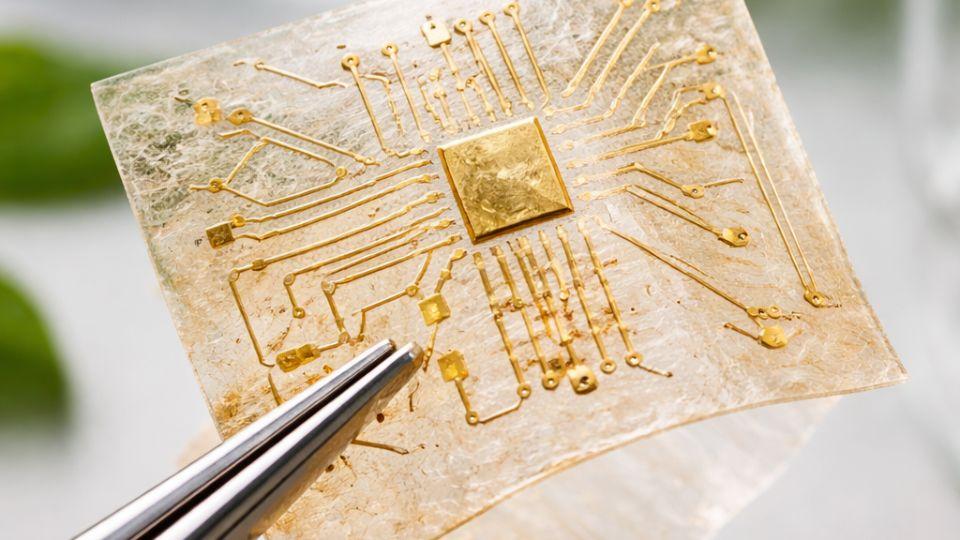
Biodegradable Electronics is an emerging technology that aims to reduce electronic waste by creating devices from materials that can break down under suitable environmental or biological conditions. As electronic gadgets, sensors, and digital systems become more common, researchers are exploring ways to make electronics that perform useful functions without remaining in the environment indefinitely. These innovations could support sustainable technology, temporary medical devices, and environmental monitoring.
Traditional electronic products often contain plastics, metals, glass, and complex circuit boards that require specialized recycling or waste treatment. Biodegradable electronics takes a different approach by designing selected components to degrade after their useful life. A growing body of research examines biodegradable conductors, semiconductors, insulating materials, and protective layers. A comprehensive review published in 2025 highlights both the environmental promise of these materials and the challenges associated with their performance, manufacturing, and safe degradation. Source
However, biodegradable does not automatically mean harmless. Researchers must evaluate the complete device, including its metals, batteries, coatings, and breakdown products. Understanding these opportunities and limitations is essential for determining where this technology can make a meaningful difference.

Biodegradable Electronics and Eco-Friendly Materials
One of the most important developments in biodegradable electronics is the discovery and improvement of materials that can provide useful electrical properties while breaking down under controlled conditions. Conventional circuit boards depend on durable materials designed to last for many years. In contrast, temporary electronic devices may use biodegradable polymers, cellulose-based substrates, silk-derived materials, and other carefully selected components.
Materials such as polylactic acid, or PLA, and polycaprolactone, or PCL, are being investigated for specific electronic applications. Natural polymers, including cellulose, silk fibroin, and chitosan, are also attracting attention because their properties can be adapted for flexible and biointegrated devices.
The main challenge is combining electrical conductivity, mechanical strength, and controlled degradation in one system. A material that breaks down easily may not survive humidity or heat during normal operation. A material that is highly durable may resist degradation for longer than intended.
Researchers are therefore developing combinations of materials rather than relying on a single biodegradable substance. These approaches could make electronic components more adaptable to their intended environments and lifetimes.
Biodegradable Electronics and Material Performance
The performance of biodegradable electronics depends on how well each component performs its specific job. Conductors must carry electrical signals, insulating layers must prevent unwanted current flow, and substrates must support the device without breaking prematurely.
Research into conducting polymers combined with natural biopolymers offers one promising direction. A 2026 review in the Journal of Materials Chemistry C discusses combinations designed to balance electrical performance, flexibility, and degradation. Read the research
Biodegradable Electronics and Material Safety
Material selection must also consider what remains after degradation. A device may lose its shape while leaving behind particles or chemical residues that persist in soil or water. Consequently, researchers need to investigate both the original materials and their breakdown products.
Biodegradable Electronics and Temporary Medical Devices
Medical technology is one of the most promising applications of biodegradable electronics. Some medical procedures require electronic devices to monitor body functions, measure signals, or provide stimulation for a limited period. Conventional devices may need to be removed through another procedure or remain inside the body longer than necessary.
Biodegradable or bioresorbable electronic systems could offer an alternative for selected temporary medical applications. Researchers are investigating sensors, neural interfaces, and other devices designed to function for a specific period before their materials break down or are absorbed under suitable conditions.
For example, a temporary sensor could help monitor a biological signal during recovery. If the device is designed for safe degradation and performs reliably, it might reduce the need for a second operation to remove it. This possibility is particularly relevant to specialized applications where long-term electronic hardware is unnecessary.
Biodegradable Electronics and Patient Safety
Medical applications require especially careful testing. The device must remain stable for the entire period in which it is needed, and its degradation products must not cause unacceptable inflammation or tissue damage.
Researchers also need to understand how temperature, moisture, and the biological environment affect its lifespan. These requirements mean that medical biodegradable electronics must pass demanding safety and performance evaluations before widespread clinical use.
Biodegradable Electronics and Smart Environmental Sensors
Environmental monitoring is another area where biodegradable electronics could become useful. Sensors are increasingly used to collect information about soil moisture, temperature, humidity, and other environmental conditions. Some monitoring projects require numerous devices distributed across large or difficult-to-reach areas.

Retrieving every sensor after use can be expensive or impractical, especially in temporary research projects. Biodegradable electronic sensors could eventually help reduce the amount of persistent hardware left behind, provided their materials and degradation products are environmentally safe.
For example, a temporary soil-monitoring sensor might collect moisture information during a particular growing season. After its useful period, selected components could be designed to degrade under specified conditions.
Biodegradable Electronics for Agricultural Monitoring
Agriculture could benefit from temporary sensors that support irrigation decisions and crop research. Farmers and researchers could use these devices to measure changing conditions without necessarily installing permanent electronic infrastructure everywhere.
Nevertheless, practical deployment requires reliable measurements throughout the intended monitoring period. Rain, sunlight, soil chemistry, and microorganisms may affect device performance differently. Researchers must also confirm that the device does not release harmful substances into agricultural land.
Biodegradable Electronics and Flexible Printed Circuits
Flexible electronics are used in wearable devices, smart labels, experimental sensors, and other systems that need to bend or conform to surfaces. Researchers are exploring whether biodegradable substrates and printable conductive materials can make some of these products less persistent after disposal.
Printing technologies can deposit conductive inks and functional materials onto thin substrates. This approach may help reduce material use and enable lightweight electronic structures. Researchers are studying combinations of natural polymers, conductive polymers, and degradable layers to produce circuits for specialized applications.
Biodegradable Electronics and Printed Circuit Design
A printed circuit must maintain electrical connections during normal use. If the substrate absorbs too much moisture, stretches excessively, or degrades prematurely, the device may stop working before its intended lifetime ends.
Researchers must therefore design circuits around their actual purpose. A short-lived sensor may not require the same durability as a laptop motherboard or industrial control system. Matching material performance to the required operating period is one of the most important principles behind this technology.
Biodegradable Electronics and Sustainable Packaging
Modern packaging increasingly includes digital features such as identification tags, temperature indicators, and tracking sensors. These features can improve product monitoring, but they may also add electronic components to packaging that is otherwise designed for recycling or composting.
Biodegradable electronics could help develop temporary electronic labels and sensors for selected packaging applications. For example, a smart label might record whether a shipment has experienced unsuitable temperatures during transportation.
Biodegradable Electronics and Smart Labels
Future smart labels may combine degradable substrates with selected conductive materials. However, packaging cannot be considered compostable simply because its paper or polymer base breaks down. Electronic components may contain metals, adhesives, batteries, or coatings that require separate treatment.
Manufacturers will need to evaluate the complete label and establish appropriate disposal methods. Clear labeling and independent testing would help prevent consumers from placing unsuitable electronic products into ordinary compost or recycling streams.
Biodegradable Electronics and Temporary Wireless Devices
Wireless sensors and identification systems can operate without a permanent wired connection. In some applications, these devices only need to function for a limited period, such as during shipping, short-term monitoring, or temporary scientific experiments.
Researchers are exploring transient electronic systems that can dissolve, disintegrate, or degrade after a defined operating period. Some experimental systems combine degradable substrates with selected conductive materials and protective layers.
Biodegradable Electronics and Controlled Lifespans
A key objective is to control when a device stops working and how quickly its materials degrade afterward. If degradation begins too early, the device may fail before completing its task. If it begins too late, the expected environmental benefit may be reduced.
Protective coatings and encapsulation layers can help control exposure to moisture or other environmental factors. Designing these layers requires a careful balance between reliability and eventual degradation.
Biodegradable Electronics and Energy Storage
Electronic devices often need an energy source, which makes energy storage an important challenge for biodegradable electronics. Researchers are investigating degradable components for batteries, capacitors, and other energy-storage systems, particularly for temporary sensors and biomedical applications.
A device cannot be considered fully biodegradable merely because its circuit substrate decomposes. Batteries may contain reactive chemicals, metals, separators, and packaging materials that require careful handling.
Biodegradable Electronics and Safer Energy Components
Future research must address energy capacity, storage stability, charging requirements, and the safe handling of degradation products. Temporary low-power sensors may be more suitable early applications than devices that require large amounts of energy.
In addition, some systems may benefit more from reusable or recoverable energy components than from complete biodegradation. The best design will depend on the application, the expected lifetime, and the environmental conditions in which the device operates.
Biodegradable Electronics and Smart Manufacturing
Manufacturing methods can strongly influence the cost, performance, and environmental impact of biodegradable electronics. Researchers are exploring printing, coating, and other fabrication techniques that can create thin electronic structures using carefully selected materials.
Smart manufacturing could help improve material placement, reduce manufacturing defects, and make the performance of biodegradable components more consistent. Artificial intelligence may also assist researchers in screening material combinations and identifying promising designs.
Biodegradable Electronics and Production Challenges
Scaling laboratory experiments into reliable commercial products remains difficult. Manufacturers must ensure that devices produced in large quantities have consistent electrical properties and predictable degradation behavior.
Production costs, material availability, storage stability, and compatibility with existing equipment also matter. Environmental assessments should consider the energy, water, and resources used during manufacturing rather than focusing only on what happens after disposal.
Biodegradable Electronics: Benefits and Hidden Risks
Biodegradable electronics could provide environmental and practical benefits, but their success depends on responsible design and testing.
| Feature | Potential benefit | Important limitation |
|---|---|---|
| Biodegradable materials | May reduce persistent waste | Not all components degrade safely |
| Temporary medical sensors | Could reduce removal procedures in selected cases | Requires rigorous biological safety testing |
| Environmental sensors | May reduce retrieval requirements | Weather and soil conditions affect degradation |
| Printed circuits | Can support lightweight designs | Conductivity and durability remain challenging |
| Smart packaging | Could enable temporary tracking | Electronic parts may complicate composting |
| Degradable energy storage | Could support temporary devices | Battery chemistry and residues need careful evaluation |
Biodegradable Electronics and Environmental Impact
The environmental value of a device depends on its complete life cycle. Manufacturing, transportation, electricity use, product lifetime, and end-of-life treatment all contribute to its overall impact.
A conventional device that lasts for years and can be repaired or recycled may sometimes be a better option than a biodegradable alternative. Conversely, a short-lived sensor that is difficult to retrieve might benefit from a carefully engineered degradable design.
Research published in npj Flexible Electronics in 2025 emphasizes that assessing degradation products is essential; the disappearance or disintegration of a device alone does not establish that it is environmentally safe. Read the study
Biodegradable Electronics: Research Progress and Future Potential
The following conceptual graph summarizes the main areas in which biodegradable electronics research may offer practical opportunities. It is an illustrative comparison of potential application relevance, not measured research data or a ranking of commercial readiness.
Illustrative potential by application
Temporary medical devices
██████████  High potential

Environmental sensors
█████████   High potential

Flexible printed circuits
████████    Promising potential

Smart packaging
████████    Promising potential

Biodegradable energy storage
██████      Developing potential

General-purpose consumer devices
█████       Significant challenges
These categories are qualitative and may change as materials improve and applications undergo testing. Temporary devices with clearly defined lifetimes may be easier to develop than general-purpose electronics expected to operate reliably for many years.
Biodegradable Electronics and Future Research Priorities
Future research will need to improve electrical performance, reliability, and control over degradation. Scientists must also establish better methods for testing the safety of breakdown products and comparing the environmental impact of different materials.
Another important priority is transparency. Manufacturers should clearly distinguish between fully biodegradable devices and products that contain only some biodegradable components. Independent testing and suitable disposal guidance can help prevent misleading environmental claims.
Conclusion: Biodegradable Electronics and a More Sustainable Future
Biodegradable electronics represents a promising direction in the search for more sustainable technology. Advances in biodegradable materials, temporary medical devices, environmental sensors, flexible circuits, smart packaging, and energy-storage research could help reduce persistent waste in selected applications.
However, these technologies are not a universal replacement for conventional electronics. Their environmental benefits depend on reliable operation, safe degradation products, responsible manufacturing, and appropriate disposal. Devices containing non-degradable components may still require recycling or specialized treatment.
As research progresses, the most successful applications will likely be those in which a limited operating lifetime is an advantage rather than a disadvantage. With careful engineering and transparent environmental testing, biodegradable electronics could become a valuable part of a broader strategy for reducing electronic waste and developing more responsible technology.