Table of Contents
- Introduction to Self-Driving Laboratories
- How Self-Driving Laboratories Work
- Eight Powerful Self-Driving Laboratory Breakthroughs
- Benefits and Hidden Risks of Self-Driving Laboratories
- Self-Driving Laboratories Comparison Table
- Future of Self-Driving Laboratories in 2026 and Beyond
- Frequently Asked Questions
- Conclusion
Introduction to Self-Driving Laboratories
Self-driving laboratories are transforming scientific research by combining artificial intelligence, robotics, automated equipment, and machine learning to perform experiments with limited human intervention. In 2026, these advanced systems are attracting attention because they could help researchers discover new materials, develop better medicines, improve chemical processes, and explore scientific questions more efficiently than traditional laboratory methods.
In a conventional laboratory, scientists often design an experiment, prepare samples, operate instruments, collect measurements, and analyze the results manually. This process can require considerable time, especially when thousands of possible combinations must be tested. Self-driving laboratories can automate many of these tasks and use experimental results to decide what to investigate next 8 Powerful Self-Driving Laboratory Breakthroughs: Hope & Risks.
A review published in Nature Reviews Chemistry on July 31, 2026, describes how self-driving laboratories have evolved from narrowly focused automation systems into more flexible research platforms. It also highlights important challenges involving scalability, generalizability, and complete experimental records. Read the 2026 review.
The promise of self-driving laboratories is not simply that robots can perform repetitive tasks. Their real potential comes from combining automated experimentation with intelligent decision-making. A system can select an experiment, run it, analyze the results, and use those results to guide the next experiment 8 Powerful Self-Driving Laboratory Breakthroughs: Hope & Risks.

However, these technologies are not fully independent scientists. They still depend on reliable equipment, suitable data, carefully defined research goals, and human oversight. Their results must be checked, and their safety limitations must be understood before they can be trusted in sensitive scientific applications.
How Self-Driving Laboratories Work
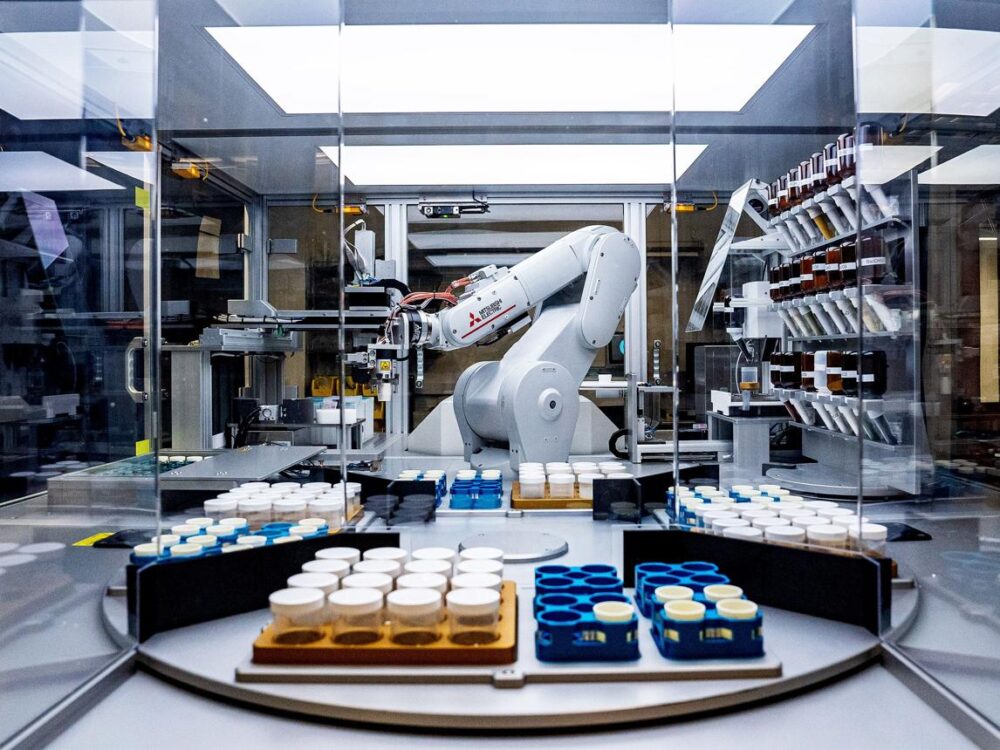
Self-driving laboratories operate through a connected system of software, experimental equipment, analytical instruments, and robotic components. The process generally begins when researchers define a scientific objective, such as identifying a stronger material, finding an effective chemical reaction, or improving the performance of a battery component 8 Powerful Self-Driving Laboratory Breakthroughs: Hope & Risks.
Artificial intelligence or an optimization algorithm then selects experimental conditions that are likely to provide useful information. Robotic equipment prepares samples, moves materials, controls instruments, or carries out reactions according to the experimental plan.
Sensors and analytical instruments collect measurements from each experiment. Machine-learning software evaluates those results and compares them with the research objective. The system then selects another experiment based on what it has learned 8 Powerful Self-Driving Laboratory Breakthroughs: Hope & Risks.
This repeated process is often called a closed-loop experimental cycle. Rather than following a fixed sequence of tests, the laboratory can adapt its choices as new information becomes available.
For example, a materials research system might test several chemical formulations, identify the most promising result, and explore nearby formulations in greater detail. Over multiple cycles, it may narrow a large search space to a smaller number of promising candidates 8 Powerful Self-Driving Laboratory Breakthroughs: Hope & Risks.
The quality of this process depends on more than AI. Accurate sensors, compatible laboratory instruments, reliable software, and well-designed experiments are all essential. If a measurement is incorrect or the equipment behaves unexpectedly, the system may make poor decisions.
Eight Powerful Self-Driving Laboratory Breakthroughs
1. Self-Driving Laboratories for Faster Materials Discovery
Materials science often requires researchers to test numerous combinations of ingredients, temperatures, processing conditions, and structures. Finding the right combination can take months or years when experiments must be planned and completed individually 8 Powerful Self-Driving Laboratory Breakthroughs: Hope & Risks.
Self-driving laboratories can accelerate this process by automatically testing promising combinations and using the results to select subsequent experiments. Machine-learning algorithms may help identify which experiment is most likely to improve performance or reduce uncertainty.
This approach is particularly valuable for battery materials, solar-cell components, catalysts, polymers, and other advanced materials. Instead of testing every possible combination, the system can concentrate on candidates that appear more promising based on earlier results.
Research published in Communications Materials in July 2026 examined the use of multi-agent AI to manage autonomous materials laboratories and coordinate broader research campaigns. Such systems could eventually help researchers explore complicated materials problems while making better use of laboratory resources.

Nevertheless, faster experimentation does not guarantee a successful discovery. The results still require independent validation, and promising laboratory materials may perform differently when manufactured at industrial scale 8 Powerful Self-Driving Laboratory Breakthroughs: Hope & Risks.
2. Self-Driving Laboratories With Advanced AI Scientists
Artificial intelligence is becoming more capable of helping scientists plan experiments and interpret results. In self-driving laboratories, AI can contribute to experimental design, identify patterns in collected data, and recommend new directions for investigation.
Some systems combine language models with scientific software and laboratory controls. This allows researchers to express a research objective in a more accessible way while specialized programs translate that objective into experimental steps.
The potential advantage is a more flexible laboratory workflow. Instead of programming every experimental choice in advance, scientists can build systems that adapt to changing results and investigate promising possibilities.
For example, an AI-supported laboratory researching catalysts might compare earlier measurements, suggest a new composition, and send that proposal to an automated experimental platform. The resulting measurements then help guide the next decision 8 Powerful Self-Driving Laboratory Breakthroughs: Hope & Risks.
However, AI-generated explanations can be incorrect, and models may misunderstand experimental constraints. Human scientists must review proposed experiments, verify important conclusions, and ensure that the system stays within safe operating limits.
3. Self-Driving Laboratories for Drug Discovery
Drug discovery involves complicated biological systems, large numbers of candidate molecules, and extensive experimental validation. Traditional research can be expensive because scientists must identify promising compounds and then determine whether they behave as expected in increasingly complex tests 8 Powerful Self-Driving Laboratory Breakthroughs: Hope & Risks.
Self-driving laboratories may automate selected stages of this process. Robotic liquid handlers can prepare samples, instruments can measure experimental responses, and algorithms can help prioritize which candidates should be tested next.
These capabilities could support research into molecular interactions, biochemical reactions, cell-based experiments, and early-stage screening. Automated workflows may also improve consistency by reducing differences introduced by repetitive manual procedures.
The biggest advantage is the possibility of testing more carefully selected candidates with less repetitive work. Scientists can spend more time interpreting meaningful findings and designing follow-up experiments 8 Powerful Self-Driving Laboratory Breakthroughs: Hope & Risks.
Yet drug discovery cannot be reduced to a simple optimization problem. Biological systems are complex, and a compound that performs well in one experiment may fail in later studies. Safety, toxicity, effectiveness, and clinical outcomes require extensive evaluation. Self-driving laboratories can assist drug research, but they cannot independently establish that a medicine is safe and effective for people.
4. Self-Driving Laboratories for Chemical Reaction Optimization
Chemical reactions can depend on several variables, including temperature, pressure, concentration, catalysts, reaction time, and solvent selection. Small changes in these conditions can produce very different results 8 Powerful Self-Driving Laboratory Breakthroughs: Hope & Risks.
Self-driving laboratories can systematically investigate these variables using automated reactors and analytical instruments. Algorithms can evaluate previous results and choose new conditions that may improve the reaction’s yield, selectivity, or efficiency.
A particularly interesting development is the use of modular and relatively affordable laboratory platforms. A report in Nature Synthesis in April 2026 described RoboChem-Flex, a flexible self-driving laboratory designed for automated reaction optimization using customizable hardware and Bayesian optimization. The platform demonstrated applications involving photochemical, biocatalytic, and thermal processes.
Such approaches could help make automated experimentation more accessible to research groups that cannot build expensive custom systems from scratch 8 Powerful Self-Driving Laboratory Breakthroughs: Hope & Risks.
However, the equipment must still be configured correctly, and the reaction products must be verified using suitable analytical methods. Automated optimization can also focus on the wrong target if researchers do not define the desired outcome carefully.
5. Self-Driving Laboratories for Battery and Clean Energy Research
Battery technologies and clean energy systems depend on materials that must balance performance, safety, durability, and cost. Finding suitable formulations can involve testing numerous chemical compositions and manufacturing conditions 8 Powerful Self-Driving Laboratory Breakthroughs: Hope & Risks.
Self-driving laboratories can help researchers investigate these possibilities more efficiently. Automated systems may prepare electrode materials, adjust experimental parameters, measure electrochemical behavior, and use the results to select new candidates.
This could support research into longer-lasting batteries, improved energy storage, and materials for renewable energy technologies. Automated experimentation may also help identify manufacturing conditions that improve consistency or reduce material waste 8 Powerful Self-Driving Laboratory Breakthroughs: Hope & Risks.
A further benefit is the ability to compare competing objectives. For example, researchers may need a material that combines good performance with lower cost and reduced dependence on scarce elements. Algorithms can help explore the trade-offs between these requirements.
Still, battery performance must be evaluated over appropriate testing periods. Early results do not necessarily predict long-term degradation, safety under abnormal conditions, or the economics of mass production. Self-driving laboratories can narrow the search, but practical energy technologies still require extensive engineering and testing.
6. Self-Driving Laboratories for Sustainable Chemistry
Sustainable chemistry aims to reduce hazardous substances, energy consumption, waste, and the environmental impact of chemical production. Self-driving laboratories could support these goals by comparing different reaction conditions and identifying more efficient processes 8 Powerful Self-Driving Laboratory Breakthroughs: Hope & Risks.
For example, an automated system might investigate whether a reaction can proceed at a lower temperature, use less solvent, produce fewer unwanted by-products, or operate with a more sustainable catalyst.
Because environmental performance involves multiple factors, researchers can design optimization methods that consider several objectives at once. A reaction with a high yield may not be the best option if it requires excessive energy or creates hazardous waste.
Self-driving laboratories may therefore help scientists compare chemical performance with resource use and environmental impact. Automated measurements can also make it easier to repeat tests under consistent conditions.
However, sustainability cannot be judged by one laboratory measurement alone. The production of raw materials, energy sources, waste treatment, and the full lifecycle of a chemical process all matter. Researchers need broader assessments before concluding that an optimized reaction is genuinely more sustainable 8 Powerful Self-Driving Laboratory Breakthroughs: Hope & Risks.
7. Self-Driving Laboratories With Collaborative Robots
Robots are a central component of many self-driving laboratories. They can transport samples, dispense liquids, operate instruments, prepare reaction vessels, and perform other repetitive tasks with consistent timing and positioning.
Recent research increasingly focuses on integrating these robots into complete experimental systems rather than treating each instrument as an isolated piece of equipment. A connected platform can coordinate sample preparation, measurement, data analysis, and subsequent experiments 8 Powerful Self-Driving Laboratory Breakthroughs: Hope & Risks.
A May 2026 perspective in npj Robotics examined how robotics could improve the capabilities of self-driving laboratories, including more rapid experimentation and the ability to handle complex research tasks.
Collaborative robotic systems may also reduce the time scientists spend on repetitive laboratory procedures. This can allow researchers to focus on scientific interpretation, experimental strategy, and unusual results that require human judgment 8 Powerful Self-Driving Laboratory Breakthroughs: Hope & Risks.
The limitations are important, however. Robots can malfunction, samples can become contaminated, and instruments from different manufacturers may not communicate reliably. Systems that handle chemicals or biological materials need suitable safeguards, emergency stops, and carefully validated operating procedures.
8. Self-Driving Laboratories for Accessible and Remote Research
Advanced laboratory equipment can be expensive and difficult for smaller institutions to maintain. Self-driving laboratories and cloud-based research facilities offer one possible way to improve access to automated experimentation.
In a remote laboratory model, researchers may submit experimental instructions, select available equipment, or analyze results without personally operating every instrument. The physical experiments are performed at a facility equipped with the necessary robotics and analytical tools.
This approach could help universities, startups, and research teams that lack the budget or space to build a complete automated laboratory. Shared infrastructure may also reduce duplicated equipment costs and support collaboration across institutions 8 Powerful Self-Driving Laboratory Breakthroughs: Hope & Risks.
However, access is not automatically equal. Remote users may face service fees, limited instrument availability, or restrictions on which experiments they can perform. Data privacy, intellectual property, cybersecurity, and the reproducibility of remotely conducted experiments also require attention.
The long-term opportunity is to make sophisticated research tools available to more scientists while maintaining transparent records, reliable quality control, and appropriate safety standards.
Benefits and Hidden Risks of Self-Driving Laboratories
The main benefit of self-driving laboratories is their ability to connect experimentation with automated analysis and decision-making. This can help scientists explore complex research problems more efficiently and reduce the time spent on repetitive tasks 8 Powerful Self-Driving Laboratory Breakthroughs: Hope & Risks.
Another advantage is experimental consistency. Properly validated automated systems can follow precise procedures and record experimental conditions, making it easier to compare results and identify sources of variation.
Self-driving laboratories may also reduce material waste by selecting informative experiments rather than testing every possible combination. In some fields, this could support faster development of advanced materials, better chemical processes, and new energy technologies.
Nevertheless, these advantages depend on system quality and appropriate research design.
One major risk is unreliable data. If sensors produce inaccurate measurements or samples are contaminated, algorithms may draw misleading conclusions. Another concern is that AI systems can select experiments that appear promising mathematically but are unsafe, impractical, or scientifically uninformative.
Automation can also create cybersecurity and safety challenges. Unauthorized access to laboratory controls could disrupt experiments or, in some environments, create physical hazards. Sensitive biological and chemical research requires appropriate access restrictions and human supervision 8 Powerful Self-Driving Laboratory Breakthroughs: Hope & Risks.
There are also economic and workforce considerations. Automated systems may reduce some repetitive tasks while increasing demand for specialists who understand robotics, software, laboratory engineering, and data analysis. Smaller research institutions may struggle to afford sophisticated equipment.
A responsible approach combines automation with human oversight, validated procedures, secure software, transparent experimental records, and independent verification of important results.
Self-Driving Laboratories Comparison Table
| Breakthrough area | Main purpose | Potential benefit | Key limitation |
|---|---|---|---|
| Materials discovery | Search for improved materials | Faster candidate screening | Scale-up and validation |
| AI scientists | Guide experimental decisions | More adaptive research | Incorrect AI conclusions |
| Drug discovery | Automate selected screening tasks | More consistent testing | Complex biological validation |
| Chemical optimization | Improve reaction conditions | Better efficiency | Incorrect optimization targets |
| Battery research | Identify promising energy materials | Improved candidate selection | Long-term performance testing |
| Sustainable chemistry | Reduce waste and resource use | More efficient processes | Full lifecycle assessment |
| Collaborative robotics | Automate laboratory procedures | Consistent repetitive work | Equipment and safety failures |
| Remote laboratories | Share access to equipment | Broader research access | Cost, privacy, and availability |
Self-Driving Laboratories: Potential Impact at a Glance
The following scores are illustrative editorial assessments of potential application relevance. They are not measured scientific results or predictions of commercial success.
| Research area | Illustrative potential |
|---|---|
| Materials discovery | 5/5 |
| Chemical optimization | 5/5 |
| Battery research | 4/5 |
| Drug discovery | 4/5 |
| Sustainable chemistry | 4/5 |
| Collaborative robotics | 4/5 |
| Remote research access | 3/5 |
| AI-directed experimentation | 4/5 |
Text-Based Graph: Research Potential
Materials discovery: █████
Chemical optimization: █████
Battery research: ████
Drug discovery: ████
Sustainable chemistry: ████
Collaborative robotics: ████
Remote research access: ███
AI-directed experimentation: ████
Scale: 1 to 5, based on qualitative discussion of potential applications. These values do not represent measured improvements, laboratory performance, or market forecasts.
Future of Self-Driving Laboratories in 2026 and Beyond
The future of self-driving laboratories will depend on making automated experimentation more reliable, flexible, affordable, and accessible. Research in 2026 increasingly focuses on connecting robotics, AI, analytical instruments, and data systems into complete workflows that can adapt to experimental results.
One important direction is the development of systems that can work across a wider range of experiments. Many current platforms are designed for particular materials, chemical reactions, or laboratory procedures. More general systems could reduce the need to build a separate custom platform for every research problem.
Another priority is better benchmarking. Researchers need reliable ways to compare how much time, money, and material different platforms require and whether their results can be reproduced by other laboratories. Standardized records of experimental conditions and decision-making will be important for evaluating scientific claims.
Shared and remote laboratory facilities may also expand access to advanced equipment. However, this will require suitable infrastructure, dependable software, strong cybersecurity, and fair access arrangements.
Ultimately, the most successful self-driving laboratories will not simply perform experiments rapidly. They will generate trustworthy data, learn from failed attempts, operate safely, and help scientists answer important questions that would otherwise be difficult to investigate.
Frequently Asked Questions About Self-Driving Laboratories
What are self-driving laboratories?
Self-driving laboratories are research systems that combine AI, robotics, automated equipment, and data analysis to design, perform, and improve experiments with limited human intervention.
How do self-driving laboratories accelerate research?
They can automate repetitive procedures, analyze experimental results, and select subsequent experiments based on earlier findings. This can reduce unnecessary testing and help researchers explore complex possibilities more efficiently.
Can self-driving laboratories replace scientists?
No. These systems can automate selected tasks and support experimental decisions, but scientists remain essential for defining research goals, validating findings, interpreting unexpected results, and ensuring safety.
Which industries can benefit from self-driving laboratories?
Potential applications include materials science, pharmaceutical research, chemistry, battery development, clean energy, biotechnology, and sustainable manufacturing.
What are the biggest risks of self-driving laboratories?
Major concerns include unreliable data, equipment failures, cybersecurity threats, unsafe experimental decisions, high setup costs, and difficulties reproducing results across different laboratories.
Are self-driving laboratories widely available in 2026?
Some specialized platforms and remote laboratory services are already operating, while more flexible systems remain under development. Availability depends on the research field, equipment requirements, budget, and access to suitable facilities.
Conclusion
Self-driving laboratories represent a powerful development in modern scientific research. By combining artificial intelligence, robotics, automated equipment, and data analysis, they can help researchers investigate materials, optimize chemical reactions, explore drug candidates, and improve energy technologies.
The most important breakthroughs are not simply about replacing manual work with machines. They involve creating systems that learn from experiments, make informed decisions about what to test next, and produce reliable scientific evidence.
At the same time, automation introduces challenges involving safety, cybersecurity, data quality, cost, and scientific accountability. These issues must be addressed before autonomous systems can be trusted with increasingly complex research tasks.
In 2026, self-driving laboratories offer significant promise, but they are best understood as powerful scientific tools rather than independent replacements for human expertise. With responsible development and careful validation, they could help make future research faster, more efficient, and more accessible.