Table of Contents
- Introduction to Space-Based Solar Power
- More Efficient Space-Based Solar Panels
- Wireless Power Transmission
- Modular Solar Power Satellites
- Robotic Assembly in Space
- Advanced Energy-Receiving Stations
- Artificial Intelligence for Satellite Control
- Space-Based Solar Power for Remote Areas
- Benefits and Risks of Space-Based Solar Power
- Comparison Table
- Future of Space-Based Solar Power
- Conclusion
Introduction to Space-Based Solar Power
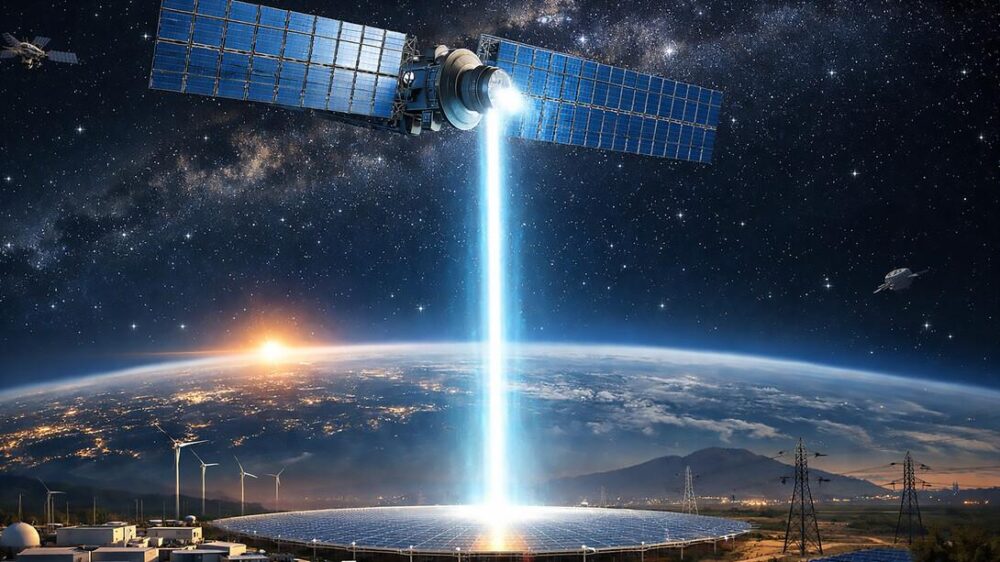
Space-Based Solar Power is an emerging energy technology that aims to collect sunlight in space and transmit the captured energy wirelessly to receiving stations on Earth. Unlike traditional solar panels, which depend on daylight and local weather, solar satellites could collect sunlight for much longer periods, depending on their orbit and system design. This approach may help provide reliable clean electricity and support the growing demand for sustainable energy.
In 2026, researchers and engineers continue exploring solar satellites, wireless energy transmission, lightweight structures, and robotic assembly. These developments could eventually make space-based energy more practical, although large-scale commercial deployment remains challenging. NASA has highlighted major obstacles, including launch costs, in-space construction, autonomous operation, and efficient power transmission. <Cite refs={[“turn920125search10″,”turn920125search3”]}/>
The idea offers exciting possibilities, but it is not a complete solution to the world’s energy problems yet. The following seven developments explain its potential benefits, important challenges, and future opportunities.
1. More Efficient Space-Based Solar Panels
One of the most important developments in Space-Based Solar Power is the improvement of solar panels and their supporting structures. Satellites must convert sunlight into electricity while keeping their overall mass, size, and operating costs manageable.

Advanced photovoltaic materials and lightweight panel designs could help collect more energy without requiring unnecessarily heavy spacecraft. In space, solar panels can receive intense sunlight without atmospheric clouds, although performance still depends on orbital conditions, panel orientation, temperature, radiation exposure, and system design.
Flexible and lightweight panels may also simplify launching and deploying large solar arrays. However, making a panel efficient is only one part of the challenge. Engineers must ensure that it remains reliable under radiation, extreme temperature changes, and years of operation.
Why it matters: Better solar panels could improve the amount of electricity generated for each kilogram of equipment launched into orbit.
2. Wireless Power Transmission Breakthroughs
Wireless power transmission is central to Space-Based Solar Power. After collecting sunlight and converting it into electricity, a satellite would transform that energy into a directed microwave or laser beam. A receiving system on Earth would capture the transmitted energy and convert it back into electricity.
Microwave transmission is often discussed for large-scale Earth-based systems because it can operate through many atmospheric conditions, although weather, beam spreading, conversion losses, and receiver design still matter. Laser-based systems may offer narrower beams, but clouds and atmospheric conditions can significantly affect their performance.
The biggest challenge is delivering useful amounts of energy across enormous distances while minimizing losses. Researchers must also develop precise beam control, safe operating procedures, and suitable receiving infrastructure.
Potential benefit: Wireless transmission could deliver energy to places where traditional power lines are difficult or expensive to build.
Main risk: Poor efficiency or inadequate beam control could reduce the system’s usefulness and create safety or regulatory concerns. <Cite refs={[“turn920125search4″,”turn920125search5”]}/>
3. Modular Space-Based Solar Power Satellites
Traditional concepts sometimes involve enormous structures that would be difficult to manufacture, launch, and assemble. Modular designs offer another approach: build a large solar power station from many smaller units that can be launched separately and connected in orbit.
Each module could contain solar collectors, power-conversion equipment, communication systems, or parts of a transmission array. If one module requires maintenance, a modular architecture might allow engineers to repair or replace that section without rebuilding the entire station.
A 2026 research paper proposed a modular phased-array architecture for very large space solar power stations. It describes a design concept rather than a fully deployed operational power station, and substantial engineering work would still be required. <Cite refs={[“turn920125search1”]}/>
Modularity could make gradual development possible. Engineers might test small systems first and increase their capacity as manufacturing and launch technologies improve.
Why it matters: Smaller, replaceable units may reduce some construction risks and support a step-by-step route toward larger systems.
4. Robotic Assembly in Space
Building a giant solar satellite entirely on Earth and launching it as one piece would be extremely difficult. Its size and mass could exceed practical launch limits. Robotic assembly could help overcome this obstacle by allowing spacecraft to connect structures and install components in orbit.
Robotic arms, autonomous inspection systems, and specialized servicing vehicles could potentially assemble solar arrays, position antennas, and replace damaged equipment. These technologies could also support repairs without requiring astronauts to perform every task manually.
However, robotic assembly introduces its own challenges. Machines must work reliably in extreme environments, identify faults, align large structures, and handle components with precision. Space debris and radiation can also threaten equipment.
NASA has identified in-space servicing, assembly, and manufacturing as important capabilities for future space infrastructure, including potential space-based solar power systems. <Cite refs={[“turn920125search10″,”turn920125search14”]}/>
Potential benefit: Robotic construction could make

large orbital energy systems easier to assemble and maintain.
Hidden risk: Technical failures could be expensive to diagnose or repair when equipment is hundreds or thousands of kilometres above Earth.
5. Advanced Energy-Receiving Stations
A solar satellite would need a ground-based receiving station to turn its transmitted energy into usable electricity. For microwave systems, this station may use a rectenna, which combines an antenna with rectifying electronics to convert incoming radio-frequency energy into direct-current electricity.
The receiving station is not simply a large antenna. Its design must account for beam alignment, conversion efficiency, land requirements, environmental effects, grid connections, and public safety. Engineers would also need to coordinate operating frequencies and prevent harmful interference with other radio services.
Receiving stations could potentially be connected to existing electricity networks or placed near remote industrial facilities. Nevertheless, a site would require suitable infrastructure, regulatory approval, and careful environmental assessment.
Why it matters: Even a highly efficient satellite cannot deliver useful electricity unless the receiving equipment can safely capture and convert the transmitted energy.
6. Artificial Intelligence for Satellite Control
Artificial intelligence could help coordinate the complex operations required by Space-Based Solar Power. A large satellite may need to manage thousands of components, maintain its orientation, monitor temperatures, detect faults, and keep its transmission beam accurately directed.
AI-assisted software could analyze sensor data, predict equipment failures, and help schedule maintenance. Automated control systems might also coordinate the movements of modular structures and adjust operating parameters as conditions change.
For example, a system could detect an unusual temperature rise in a power-conversion unit and recommend reducing its load before the problem becomes more serious. This is a potential application, not a guarantee that AI will prevent failures.
Critical controls would still need independent safety mechanisms, cybersecurity protections, and human oversight. An incorrect software update or compromised control system could interrupt power delivery or affect beam alignment.
Potential benefit: Intelligent monitoring may improve reliability and reduce unnecessary maintenance.
Main risk: Complex automated systems create additional software, cybersecurity, and verification challenges.
7. Space-Based Solar Power for Remote Areas
Reliable electricity remains difficult to provide in some remote regions, isolated industrial sites, and areas with weak transmission infrastructure. Space-Based Solar Power could eventually offer another source of energy if the technology becomes affordable and practical.
A satellite system might supply electricity to a receiving station that connects to a local microgrid. Such a system could potentially complement terrestrial solar panels, wind turbines, batteries, and backup generators.
However, space-based power would not automatically be cheaper or easier than local renewable energy. A remote community might benefit more immediately from conventional solar panels, batteries, or a small wind system. Space-based electricity would need to demonstrate competitive costs, dependable delivery, and practical maintenance arrangements.
The strongest early opportunities may be specialized applications where reliable energy has unusually high value. Researchers must compare those uses against alternatives instead of assuming every region would benefit equally.
Why it matters: Space-based solar power could eventually provide another option for locations where reliable clean energy is difficult to obtain.
Benefits and Risks of Space-Based Solar Power
Space-Based Solar Power offers several potential advantages. Orbital solar collectors could operate for extended periods without the same day-night interruptions experienced by many ground-based solar installations. Wireless energy transmission could also provide flexibility in how electricity reaches selected receiving sites.
Nevertheless, the technology faces major economic and engineering barriers. Launching equipment, assembling large structures, maintaining satellites, and converting energy at every stage could make the electricity expensive. Its total environmental impact would also depend on manufacturing, launches, replacement rates, and the energy source it actually displaces.
A 2026 article in Nature Reviews Clean Technology emphasizes the importance of a risk-managed development pathway rather than relying on optimistic promises alone. <Cite refs={[“turn920125search3”]}/>
The following table summarizes the main opportunities and limitations.
Space-Based Solar Power Comparison Table
| Technology | Potential benefit | Major challenge |
|---|---|---|
| Advanced solar panels | More electricity per unit of mass | Radiation and long-term durability |
| Wireless transmission | Delivers energy without physical cables | Conversion losses and beam control |
| Modular satellites | Gradual construction and easier replacement | Complex coordination |
| Robotic assembly | Supports large orbital structures | Reliability and repair difficulties |
| Rectenna receiving stations | Converts transmitted energy into electricity | Land use and safe operation |
| AI-assisted control | Monitoring and predictive maintenance | Cybersecurity and software failures |
| Remote-area power delivery | Could support isolated microgrids | Cost and competition from local renewables |
Space-Based Solar Power Progress Graph
The graph below is a qualitative illustration of development stages, not measured performance data or a forecast. It shows how a project could progress from early research toward commercial deployment.
<Chart content={{“chartType”:”bar”,”meta”:{“title”:”Illustrative Space-Based Solar Power Development Path”,”description”:”Conceptual maturity scale from early research to possible commercial use; not measured data.”},”xKey”:”stage”,”series”:[{“dataKey”:”level”,”label”:”Illustrative maturity”,”valueFormat”:”integer”}],”yAxisMin”:0,”yAxisMax”:5,”data”:[{“stage”:”Research”,”level”:1},{“stage”:”Ground tests”,”level”:2},{“stage”:”Orbital demos”,”level”:3},{“stage”:”Pilot systems”,”level”:4},{“stage”:”Large-scale use”,”level”:5}]}}/>
Large-scale use remains a future possibility, not an established outcome. Each stage would require verified technical performance, economic assessment, safety testing, and regulatory approval.
Future of Space-Based Solar Power
The future of Space-Based Solar Power will depend on whether researchers can solve several challenges together. More efficient solar cells alone will not make the technology commercially viable. Launch costs, lightweight structures, robotic construction, wireless transmission efficiency, receiver infrastructure, and long-term maintenance must all improve.
A sensible development strategy would begin with small demonstrations that measure how much energy is collected, transmitted, and delivered to a useful load. Researchers could then compare real performance with the costs and environmental impacts of ground-based renewable systems.
International cooperation may also be important because wireless power transmission, orbital operations, radio-frequency coordination, and space debris affect more than one country. Clear safety standards and transparent testing would help establish public confidence.
If these challenges are addressed, space-based solar power could become a useful complement to other clean-energy technologies. It is unlikely to replace every solar farm, wind turbine, battery, or conventional power plant, but it may eventually serve specific applications where continuous energy delivery is especially valuable.
Conclusion
7 Powerful Space-Based Solar Power Breakthroughs: Hope & Risks highlights a promising idea that combines solar energy, satellite engineering, wireless transmission, robotics, and intelligent control. More efficient panels, modular structures, advanced receiving stations, and automated maintenance could help move the concept toward practical demonstrations.
The positive outlook is clear: space-based systems may one day provide another source of reliable, low-carbon electricity. The risks are equally important, including high costs, energy losses, orbital maintenance, environmental impacts, and safety requirements.
For now, Space-Based Solar Power remains an emerging technology rather than a proven, large-scale energy solution. Careful experiments and realistic economic comparisons will determine whether its promise can become a practical part of the world’s clean-energy future.