Table of Contents
- What Is DNA Data Storage?
- 7 Powerful DNA Data Storage Breakthroughs
- Benefits of DNA Data Storage
- Hidden Risks and Challenges
- DNA Data Storage Comparison Table
- DNA Data Storage Research Progress Graph
- The Future of DNA Data Storage
- Conclusion
What Is DNA Data Storage?
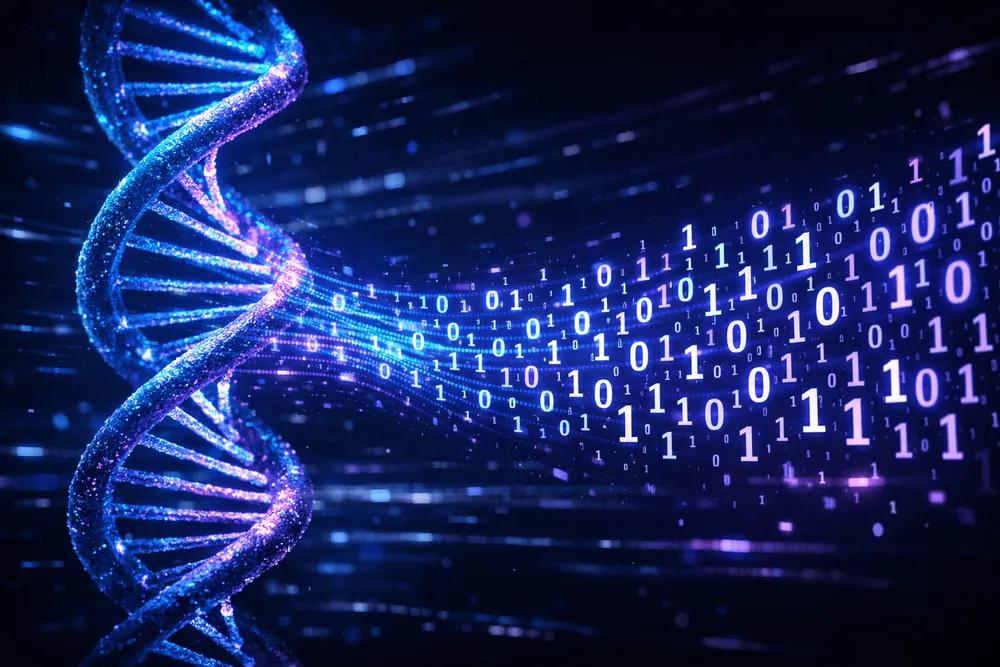
DNA data storage is a method of encoding digital information into DNA molecules. Computers normally represent information using binary digits, or bits, made up of zeros and ones. In DNA storage, specialized encoding methods convert this information into sequences represented by four chemical bases: adenine, cytosine, guanine, and thymine.
After encoding, synthetic DNA is produced and preserved in an appropriate storage environment. When the information is needed, scientists read the DNA sequence using sequencing technologies and decode it back into digital files.
Unlike conventional hard drives, DNA does not require continuous electrical power simply to preserve information when stored appropriately. Its molecular structure also offers exceptional theoretical information density. However, writing and reading DNA currently require specialized processes that are generally more expensive and slower than everyday digital storage.

7 Powerful DNA Data Storage Breakthroughs
1. DNA Data Storage with Higher Information Density
One of the biggest advantages of DNA data storage is its potential to preserve enormous quantities of information in very little physical space. DNA molecules can encode information at a molecular scale, making them attractive for long-term digital archives.
Researchers are developing improved encoding strategies to store more usable information in each DNA sequence. These methods must account for biological constraints, including repeated bases, sequence composition, and structures that can interfere with DNA synthesis or reading.
In August 2026, research published in Nature Communications examined practical coding methods aimed at improving DNA storage density. Such work could help make molecular storage more efficient without sacrificing reliable decoding. <Cite refs={[“turn806162search5”]}/>
The potential benefit is substantial: organizations may eventually preserve vast archives in compact physical formats. However, theoretical capacity is not the same as practical capacity. Error correction, indexing, and other technical requirements affect how much information a complete storage system can reliably hold.
2. DNA Data Storage with Faster Information Retrieval
Storing data is only useful if the correct information can be retrieved when needed. Traditional DNA storage workflows can require molecular preparation, sequencing, and computational decoding, which may make access slower than retrieving files from conventional drives.
Researchers are investigating random-access methods that allow a system to locate selected DNA sequences without reading an entire archive. Techniques involving molecular addressing, targeted selection, and physical separation of DNA pools may help improve this process.
A 2026 review in Trends in Biotechnology described how random access is becoming an important step toward making DNA storage operate more like an organized data system. <Cite refs={[“turn806162search2”]}/>
Better retrieval could make DNA storage more useful for large archives where only certain files are needed at a time. Nevertheless, it is not yet a general replacement for instant-access digital storage. Retrieval speed, system complexity, and the cost of reading selected information still need improvement.

3. DNA Data Storage with Better Error Correction
DNA molecules can be damaged, lost, or read incorrectly during storage and retrieval. Even a small number of errors can make a digital file difficult to reconstruct unless the system includes appropriate safeguards.
To address this problem, scientists use error-correction algorithms that add carefully designed redundancy to encoded information. If some DNA sequences become unreadable or contain errors, the decoding system can use the remaining information to recover the original file.
Researchers continue to improve coding strategies that combine efficient storage with reliable reconstruction. These methods are especially important for archives that must remain accurate for many years.
Better error correction could make DNA storage more dependable for preserving scientific records, historical documents, and valuable datasets. However, error correction adds overhead and cannot guarantee recovery if too much information is damaged or missing. Reliable preservation therefore requires both good encoding and suitable physical storage conditions.
4. DNA Data Storage Using More Stable Molecular Materials
Ordinary DNA can degrade when exposed to damaging environmental conditions, including unsuitable temperatures, moisture, ultraviolet radiation, and certain chemicals. Protecting the molecules is essential if DNA data storage is to become a practical long-term preservation method.
Researchers are investigating protective approaches such as encapsulation, specialized coatings, and alternative nucleic-acid structures. These approaches aim to improve stability and protect stored information against chemical or biological damage.
A 2026 review in Nature Communications examined non-canonical nucleic acids, including modified molecular structures that may offer different stability properties from conventional DNA and RNA. <Cite refs={[“turn806162search1”]}/>
Improved preservation could help archives retain information for extended periods with limited maintenance. However, the durability of a particular material depends on its composition and storage environment. Claims about centuries or millennia of preservation must be supported by evidence, and accelerated aging tests do not perfectly predict every long-term outcome.
5. DNA Data Storage with Improved Writing and Reading Methods
DNA storage systems need two essential capabilities: writing information into molecular sequences and reading those sequences back accurately. Writing generally involves synthesizing DNA, while reading often involves sequencing the stored molecules.
Both processes can be expensive and technically demanding. Researchers are investigating new synthesis methods, improved sequencing workflows, and more efficient decoding algorithms to reduce the cost and time required for data storage.
Enzymatic DNA synthesis is one area of interest because researchers are exploring alternatives to conventional chemical synthesis. Improvements in sequencing and computational processing may also make it easier to recover information from smaller or more complex samples.
These advances could help move DNA storage beyond specialized demonstrations toward more practical archival systems. Even so, improvements in one stage do not automatically solve every bottleneck. A useful system must combine affordable writing, dependable preservation, accurate reading, and efficient decoding.
6. DNA Data Storage for Improved Security
DNA data storage has potential security advantages because molecular archives can be physically separated from ordinary computer networks. An offline archive may be less exposed to certain remote cyberattacks than a network-connected storage system.
Researchers are also exploring molecular techniques designed to control copying or improve the protection of encoded information. A 2026 Nature Communications study introduced a DNA storage approach called ZAT-DNA that uses distinctive molecular encoding to resist ordinary polymerase-based amplification. The researchers demonstrated storage and retrieval of small cryptographic keys in their experimental system. <Cite refs={[“turn806162search9”]}/>
Such approaches could eventually contribute to specialized secure storage applications. However, DNA is not automatically secure merely because it is a biological molecule. Physical theft, unauthorized sequencing, poor handling, and weaknesses in the surrounding computer systems can still expose information.
Strong security requires multiple layers of protection, including access controls, appropriate encryption, secure handling, and reliable recovery procedures.
7. DNA Data Storage for Long-Term Digital Archives
The growing volume of digital information creates a challenge for organizations that must preserve records for decades. Magnetic tape and other conventional technologies remain useful, but archives must manage equipment replacement, storage conditions, and long-term maintenance.
DNA offers a different approach because properly preserved molecules may retain encoded information for extended periods without continuous electrical power. Potential applications include historical collections, scientific datasets, cultural heritage, and records that rarely need to be accessed.
Researchers are working to improve the entire process, from encoding and synthesis to preservation and retrieval. The aim is not necessarily to replace everyday storage devices, but to provide another option for information that must remain available over long periods.
The major challenge is economic practicality. DNA storage must become affordable, dependable, and straightforward to operate before it can serve as a widespread archival solution. For now, its strongest potential is in specialized use cases where storage density and long-term preservation matter more than frequent access.
Benefits of DNA Data Storage
DNA data storage offers several potential advantages over conventional storage technologies for specific applications.
Its most distinctive feature is information density. DNA can theoretically store large amounts of information in a very small mass of material. This could be valuable for institutions managing extensive archives that would otherwise occupy considerable physical space.
Another benefit is long-term preservation. When DNA is prepared and stored under appropriate conditions, it can retain information over extended periods. This could help protect important cultural, scientific, and historical records.
DNA also offers the possibility of low-energy preservation because stored molecules do not require continuous electrical power to maintain their information. However, energy is still required to create, process, retrieve, and manage the data.
Finally, DNA storage could complement conventional systems by providing a specialized archival medium. Instead of replacing every hard drive or cloud service, it may become useful for selected information that is rarely accessed but must be preserved.
Hidden Risks and Challenges of DNA Data Storage
Despite its promise, DNA data storage faces several significant limitations.
The first is cost. DNA synthesis, sequencing, and associated laboratory processes remain expensive compared with conventional digital storage. Further improvements in production and automation will be necessary for broader adoption.
The second challenge is access speed. Finding and decoding a file from DNA can require multiple laboratory and computational steps. This makes the technology unsuitable for many applications that need instant access or frequent updates.
Molecular damage is another concern. DNA can degrade under unfavorable conditions, and errors during synthesis or sequencing may affect the accuracy of recovered files. Protective storage and error-correction methods help, but they do not eliminate every risk.
DNA archives can also be difficult to update. Conventional digital files can be overwritten or modified easily, while changing DNA-based records may require additional synthesis and processing.
Finally, privacy and security must be considered. Sensitive information requires robust encryption, controlled physical access, and careful management of stored samples. DNA storage should be viewed as a specialized technology with distinctive benefits and challenges, not as a perfect solution for every data problem.
DNA Data Storage Comparison Table
The following table provides a qualitative comparison of DNA storage with conventional technologies. Actual performance varies according to the specific system and application.
| Feature | DNA data storage | Conventional digital storage |
|---|---|---|
| Information density | Very high theoretical potential | Varies by device |
| Long-term preservation | Promising under suitable conditions | Depends on medium and maintenance |
| Energy for passive preservation | Potentially low | Varies by medium and storage setup |
| Writing and retrieval | Specialized molecular processes | Usually faster and more accessible |
| Current cost | Generally high | Usually lower for everyday uses |
| Updating files | Technically demanding | Generally straightforward |
| Best potential use | Specialized long-term archives | Everyday computing and active data |
DNA Data Storage Research Progress Graph
The following conceptual graph compares major research areas by their general development stage. It is illustrative rather than a measured scientific ranking.
Illustrative development scale
| Research area | General development stage |
|---|---|
| DNA encoding methods | █████ Advanced research |
| Error-correction techniques | ████ Developing |
| Molecular preservation | ████ Developing |
| DNA synthesis and sequencing | ████ Developing |
| Random-access retrieval | ███ Developing |
| Molecular security methods | ███ Emerging |
| Large-scale everyday deployment | ██ Early-stage |
The graph illustrates that important components of DNA data storage have advanced considerably, but integrating them into an affordable, fast, and easy-to-use system remains a major challenge. Different methods may be at different stages, so these labels should not be interpreted as official performance scores.
The Future of DNA Data Storage
The future of DNA data storage will depend on improvements across the complete information lifecycle. More affordable DNA synthesis could reduce the cost of writing information, while faster sequencing and smarter decoding could improve retrieval.
Researchers may also develop better molecular protection methods, more efficient error-correction systems, and new approaches to locating specific files within large DNA archives. These improvements could make the technology more attractive to museums, research institutions, libraries, and organizations that preserve valuable information.
Another important direction is integration with conventional computing infrastructure. DNA storage will be more practical if organizations can manage molecular archives using familiar software and reliable automated systems.
However, widespread adoption is not guaranteed. Costs, access speeds, physical durability, and operational complexity must all improve together. DNA storage is most likely to complement traditional technologies first, particularly for information that must be preserved for a long time and rarely needs to be retrieved.
Conclusion: DNA Data Storage Offers Hope and Risks
DNA data storage is a powerful scientific concept that could help preserve humanity’s growing digital archives. Advances in information density, random-access retrieval, error correction, molecular stability, synthesis, security, and long-term archiving are bringing the field closer to practical applications.
The technology still faces important challenges, especially high costs, slow retrieval, molecular degradation, and difficult updates. These limitations mean that conventional storage remains the more practical choice for most everyday digital tasks.
As research progresses, DNA may become a valuable additional option for preserving information that matters over long periods. The best outcome will come from combining scientific innovation with realistic expectations, careful testing, and strong security practices.